







How to Make a Forex Withdrawal on GTC Go (GTCFX Guide)?
GTC Go is GTCFX's mobile trading app, giving traders quick access to accounts, markets, and fund management. As a regulated forex broker, GTCFX aims to make ev…
OCT 15, 2026
00
Blogs
Last updated: august 13, 2026 at 1:34 pm
According to the research team of GTCFXs, the foreign exchange market represents the largest and most liquid financial market globally, with approximately $6.6 trillion traded daily across multiple time zones.
Understanding the fundamentals of forex trading has become essential for aspiring traders and investors seeking alternative investment opportunities in the dynamic world of currency exchange markets.
Forex trading, commonly referred to as FX trading or foreign exchange trading, represents the process of buying and selling one currency in exchange for another with the primary objective of generating profit from fluctuations in exchange rates. The foreign exchange market serves as the backbone of international commerce, enabling businesses, governments, and investors to conduct cross-border transactions seamlessly and efficiently.
At its core, what forex trading means involves the simultaneous exchange of currency pairs, where traders speculate on currency appreciation or depreciation. When someone engages in how forex trading works, they are essentially predicting whether one currency will strengthen or weaken relative to another. For instance, if you believe the Euro will strengthen against the US Dollar, you would purchase the EUR/USD currency pair, anticipating profitable returns as the exchange rate shifts favourably.
According to the GTCFX team's extensive analysis, the forex market operates as a decentralized network without a central physical location. Unlike stock markets functioning during specific business hours, this global currency market operates 24 hours a day, five days a week, spanning across major financial centres including Sydney, Tokyo, London, and New York, providing unprecedented trading accessibility.
The true meaning of forex trading encompasses far more than simple currency exchange; it represents a sophisticated financial instrument where participants capitalize on international economic differences and market sentiment shifts. Every currency pair embodies the economic relationship between two nations, and traders utilize this understanding to execute profitable trading decisions based on fundamental and technical analysis.
Forex trading meaning extends beyond theoretical understanding to practical application. Successful traders recognize that currency movements reflect broader economic trends, geopolitical developments, and central bank policies. This comprehensive perspective transforms what seems like simple number-trading into informed decision-making aligned with global economic realities.
Currency pairs form the foundation of all forex trading transactions. Each pair consists of two currencies: the base currency and the quote currency. In the EUR/USD pair, the Euro serves as the base currency while the US Dollar acts as the quote currency. The exchange rate indicates how many units of the quote currency are needed to purchase one unit of the base currency.
Major currency pairs dominate forex trading volume, with the EUR/USD maintaining approximately 22.7% of daily forex turnover. According to the GTCFX research team, understanding major currency pairs remains fundamental for both novice and experienced traders seeking consistent profitability and reduced volatility exposure.
The traditional major pairs include EUR/USD (Euro/US Dollar, nicknamed "Fiber"), USD/JPY (US Dollar/Japanese Yen, or "Gopher"), GBP/USD (British Pound/US Dollar, known as "Cable"), and USD/CHF (US Dollar/Swiss Franc, called "Swissie"). These pairs command the highest trading volumes globally and offer the tightest spreads for optimal execution quality.
Commodity currency pairs featuring the Australian Dollar (AUD/USD or "Aussie"), Canadian Dollar (USD/CAD or "Loonie"), and New Zealand Dollar (NZD/USD or "Kiwi") represent alternative major pairs with strong correlations to commodity prices. Cross-currency pairs, which exclude the US Dollar entirely, include EUR/GBP ("Chunnel"), EUR/JPY ("Yuppy"), and EUR/CHF, offering additional diversification opportunities for sophisticated traders.
Understanding how forex trading works requires grasping several interconnected mechanisms that operate simultaneously within this complex market environment.
When traders engage in forex trading and how it works practically, they navigate through bid-ask spreads, leverage mechanisms, and various order types to execute their trading strategies effectively and minimize transaction costs.
Every forex quotation involves two prices: the bid price and the ask price. The bid represents the price at which buyers are willing to purchase a currency pair, while the ask reflects the price at which sellers are willing to sell. The difference between these prices constitutes the spread, measured in pips, which represents trading costs.
A pip, meaning "percentage in point," represents the smallest standardised price movement in forex trading operations globally. For major currency pairs excluding the Japanese Yen, a pip equals 0.0001 (four decimal places). For JPY pairs, one pip equals 0.01 (two decimal places) due to the Yen's significantly lower value compared to Western currencies. Understanding pips proves critical because all profits and losses are calculated in pip movements throughout trading careers.
If you observe EUR/USD trading at a bid price of 1.1050 and an ask price of 1.1052, the two-pip spread means you would lose two pips immediately upon opening a position before any favourable price movement could generate profit. This spread structure serves as the primary revenue mechanism for forex brokers operating globally.
Leverage in forex trading enables traders to control positions significantly larger than their account balance. GTCFX team emphasizes that while leverage amplifies profit potential substantially, it equally magnifies losses, making proper risk management absolutely essential for long-term survival. Leverage is expressed as ratios, such as 50:1, 100:1, or 500:1, depending on the broker and regulatory framework governing their jurisdiction.
Margin represents the collateral required to maintain a leveraged position actively. With 50:1 leverage and a margin requirement of 2%, a trader can control a $50,000 position with just $1,000 of their capital. If EUR/USD moves 1% in their favour, they profit $500 on their $1,000 investment—representing a 50% return on investment. Conversely, if markets move 1% against them, they lose $500, representing a 50% loss.
Forex trading strategies and margin requirements demand constant vigilance and monitoring. A margin call occurs when account equity falls below the required margin level, triggering forced position closure. This risk management mechanism underscores why understanding leverage mechanics proves absolutely fundamental to successful forex trading approaches.
The efficiency and tight spreads characteristic of forex markets exist primarily because of forex liquidity distribution across major financial institutions globally. Liquidity providers ensure sufficient trading capital flows through the market consistently, enabling large orders to execute without dramatically affecting prices adversely.
According to GTCFX's research, understanding liquidity providers and their essential role helps traders recognise why certain currency pairs offer superior trading conditions compared to others. Major currency pairs benefit from extensive liquidity, resulting in tighter spreads and faster execution speeds. Being aware of liquidity gaps in forex trading helps traders avoid entering positions during low-liquidity periods when spreads widen significantly and slippage increases dramatically.
Selecting the optimal forex trading platform represents one of the most consequential decisions a trader makes during their market journey. The best forex trading platform combines user-friendly interface design, advanced charting tools, reliable order execution, and comprehensive educational resources. When evaluating what is the best forex trading platform specifically for your needs is, consider MetaTrader 4 (MT4) and MetaTrader 5 (MT5), which dominate the industry due to their sophisticated features and extensive indicator libraries available globally.
Mobile forex trading apps have revolutionized market access, enabling traders to monitor positions and execute trades from anywhere globally without geographic restrictions. When selecting the best forex trading app for your trading style, prioritize platforms offering real-time price quotes, one-click trading capabilities, risk management tools, and push notifications for important price alerts triggering your interest levels.
According to the GTCFX team's comprehensive platform analysis, choosing the right liquidity provider directly impacts your trading execution quality significantly. Superior liquidity providers ensure consistent spreads and faster order fulfilment during volatile market conditions requiring quick execution. Visit the GTCFX main platform to explore comprehensive trading solutions designed for both beginners and professional traders seeking institutional-quality services.
For Indian traders seeking forex trading , the fundamental principles remain identical—exchanging one currency for another with profit objectives driving decisions. However, what is forex trading in India involves specific regulatory frameworks and unique market characteristics worth understanding thoroughly before committing capital.
Forex trading in India operates under stringent regulations from the Securities and Exchange Board of India (SEBI), ensuring trader protection. Indian traders access forex markets primarily through recognized stock exchanges, including the National Stock Exchange (NSE) and Bombay Stock Exchange (BSE). Currency pairs commonly traded by Indian traders include USD/INR, EUR/INR, and GBP/INR, reflecting the Indian Rupee's importance in forex markets globally.
What is the best forex trading platform in India that focuses on SEBI-regulated brokers providing competitive spreads, robust trading platforms, and comprehensive educational support materials? The forex market hours in India operate from 9:00 AM to 5:00 PM IST, with extended cross-currency trading available until 7:30 PM IST for committed traders.
A demo account in forex trading provides an invaluable risk-free environment for learning market mechanics without risking real capital immediately. What is a demo account in forex trading exactly? It's a virtual trading account funded with simulated money that mirrors live market conditions precisely, allowing traders to practice strategies, familiarise themselves with trading platforms, and build confidence before committing actual funds to the market.
Demo accounts in forex trading offer several critical advantages for beginner traders entering markets. First, they eliminate financial risk during the learning phase completely, allowing traders to make mistakes without real-world financial consequences affecting their livelihoods. Second, they provide access to real-time market data and authentic price movements, ensuring practice reflects actual market conditions accurately. Third, traders can test various strategies systematically, from trend trading to breakout trading, observing performance metrics in realistic scenarios.
When learning what is a demo account in forex trading is, beginners discover that demo accounts simulate legitimate trading environments, including realistic features:
However, the GTCFX team notes important distinctions between demo and live trading scenarios. Demo accounts eliminate emotional pressure since no real money is at risk, potentially leading to more aggressive trading behaviour than traders would exhibit with live funds. Slippage and market volatility effects may not be fully represented in simulated environments compared to actual live conditions.
Understanding forex trading time and market hours proves essential for optimizing trading opportunities throughout global sessions. The forex market time operates continuously from Sunday 5:00 PM EST through Friday 5:00 PM EST, creating a 24-hour trading environment across major financial centers without interruption.
In India, the forex trading hours align with 9:00 AM to 5:00 PM IST standard trading sessions, with extended hours until 7:30 PM IST for cross-currency trading operations.
The overlapping London-New York session coincides with Indian afternoon hours, providing optimal trading conditions specifically for Indian participants seeking maximum liquidity levels.
Understanding the benefits of forex trading helps traders appreciate why this market attracts millions of participants globally seeking financial independence. Forex trading benefits include numerous advantages:
24/7 Market Access: Unlike stock markets with restricted trading hours, forex trading operates continuously, accommodating traders regardless of geographic location or schedule constraints. Part-time traders can participate during evenings or weekends when other markets remain closed completely, enabling flexible participation schedules aligned with personal situations.
High Liquidity: With $6.6 trillion exchanged daily globally, forex markets offer unmatched liquidity compared to stocks, commodities, or cryptocurrencies available. This immense trading volume ensures positions can be entered and exited swiftly without substantial price slippage affecting profitability negatively. Tight spreads benefit all trader types equally.
Leverage Opportunities: Forex brokers provide leverage ratios reaching 100:1 or higher in many jurisdictions, enabling traders to control substantial positions with modest capital requirements. A trader with $1,000 can control positions worth $100,000, amplifying profit potential substantially. This amplification attracts ambitious traders seeking maximum returns possible.
Low Transaction Costs: Forex spreads remain remarkably tight compared to traditional stock trading commissions charged. Particularly for major currency pairs, spreads are minimal, making transaction costs nearly negligible compared to other trading venues. Brokers earn revenue through spread differentials rather than commissions, aligning trader and broker interests perfectly.
Bidirectional Profit Potential: Currency pairs can be traded long (buying) or short (selling), enabling traders to profit from both rising and falling markets. This flexibility eliminates sidelining during downturns that devastate stock market participants. Professional traders exploit both directions equally effectively.
Diverse Currency Pair Selection: From highly liquid major pairs to exotic combinations featuring emerging market currencies, traders can select pairs matching their expertise and preferred trading sessions. Specialization enables deeper market knowledge development.
While forex trading offers substantial benefits, the GTCFX research team emphasizes that equally significant risks accompany these opportunities, demanding careful consideration before participation.
Leverage Amplifies Losses: The same leverage enabling 50% gains on favorable 1% moves creates 50% losses on adverse movements unfavorably. Traders unprepared for this amplification suffer rapid account depletion catastrophically. Margin calls force position closure at the worst possible times, crystallizing losses immediately.
Market Volatility: Sudden economic announcements, geopolitical events, or central bank decisions trigger extreme volatility unexpectedly, potentially generating losses despite accurate directional prediction. Black swan events destroy unprepared traders' accounts rapidly without warning signals provided.
Emotional Pressure: Real money on the line creates psychological stress that demo trading cannot replicate authentically. Fear and greed often override rational decision-making processes, leading to impulsive trades and poor risk management. Experienced traders acknowledge emotion management as a crucial skill.
Complex Market Dynamics: Successfully navigating forex requires understanding technical analysis, fundamental analysis, economic indicators, and geopolitical factors comprehensively. This complexity overwhelms novice traders lacking proper education and structured learning approaches systematically.
Margin Calls: Inadequate risk management can trigger margin calls, forcing position closure at unfavourable prices and crystallizing losses before market recovery occurs. Professional risk management prevents these catastrophic scenarios reliably.
According to the GTCFX team's strategic analysis, successful forex trading requires systematic approaches rather than random speculation and guesswork. Professional traders combine multiple strategies based on market conditions and personal expertise.
Trend trading remains the most popular and accessible strategy for beginners entering the forex markets. This approach involves identifying prevailing market direction and trading in alignment with that direction consistently. Technical indicators, including moving averages, MACD, helps me identify trend strength accurately and potential reversals before they occur.
When EUR/USD exhibits consistent upward movement over extended periods, trend traders purchase positions (go long), anticipating continued appreciation. Conversely, during downtrends, they sell positions (go short), profiting from declining prices. This methodology reduces risk significantly.
Breakout trading capitalizes on price movements beyond established support or resistance levels previously tested. When EUR/USD breaks above a resistance level with increased volume confirming strength, this signals potential trend continuation, prompting traders to enter long positions confidently. Breakouts identify momentum shifts early.
Carry trading profits from interest rate differentials between currency pairs held overnight. If the Australian Dollar offers 4.5% interest while the Japanese Yen offers 0.5%, traders holding AUD/JPY positions earn the 4% differential through overnight swap fees consistently. This strategy generates passive income.
Understanding economic indicators affecting forex prices helps traders anticipate currency movements before they materialize, enabling profitable positioning. Major economic data releases drive significant volatility.
Interest Rates: Central banks' interest rate decisions profoundly impact currency values significantly. Higher interest rates attract foreign investment seeking superior returns consistently, strengthening the local currency. The US Federal Reserve's rate decisions directly influence USD strength, affecting virtually all currency pairs traded globally.
Inflation Data: Consumer Price Index (CPI) readings reveal inflation trends clearly, guiding central bank decisions accordingly. Rising inflation typically prompts rate increases, strengthening currencies. Deflation concerns trigger rate cuts, weakening currencies unfavorably.
Employment Data: Non-Farm Payrolls in the United States reveal labour market health accurately. Strong employment data support economic growth narratives, strengthening the USD. Traders anticipate these reports weeks in advance.
GDP Growth: Gross Domestic Product figures demonstrate economic expansion or contraction. Robust GDP growth supports currency appreciation as investors increase capital inflows to growing economies seeking returns. Weak growth triggers currency weakness.
GTCFX Expert Tip 1: Always implement stop-loss orders on every position without exception. This critical risk management tool automatically closes losing trades at predetermined price levels, preventing catastrophic losses during unexpected market movements. Professional traders never risk more than 2% of their account balance on a single trade consistently.
GTCFX Expert Tip 2: Utilize demo accounts extensively before transitioning to live trading with real capital. GTCFX research indicates that traders spending 3-6 months practising on demo platforms develop superior discipline and decision-making capabilities compared to those rushing into live trading unprepared and undereducated.
GTCFX Expert Tip 3: Maintain a detailed trading journal documenting every trade executed, including entry rationale, exit price, and performance results systematically. This analytical approach reveals behavioural patterns and systematic strengths/weaknesses that guide strategy refinement. Successful traders review journals regularly.
Industry Expert Statement: "Forex trading represents the most accessible financial market globally, enabling individuals with minimal capital to participate in massive liquidity pools.
However, this accessibility attracts unprepared traders lacking adequate risk management discipline. Success requires education, emotional control, and systematic strategy implementation rather than speculation."
GTCFX Research Finding: According to a comprehensive analysis of successful traders examined, those implementing strict risk management protocols and adhering to predetermined trading plans generate consistent profits reliably, while emotional traders attempting to recover losses rapidly experience account destruction. Discipline separates winners from losers consistently.
According to GTCFX research and expert team analysis, this comprehensive guide addresses critical knowledge gaps affecting trader success rates significantly. Understanding what forex trading is fundamentally improves decision-making across all market conditions and timeframes. The detailed explanation of currency pairs, leverage mechanics, and market structure provides the foundational knowledge essential for profitable trading approaches.
GTCFX team recognizes that accessible, well-structured information transforms market participation from reckless speculation into disciplined investment activity. By clarifying core concepts, including pips, spreads, demo accounts, and economic indicators thoroughly, this blog empowers traders to navigate complex markets with confidence and conviction daily. Knowledge reduces emotional reactions.
Understanding what forex trading is represents the crucial first step toward informed the market participation confidently. According to the GTCFX team, grasping fundamental concepts, including currency pairs, leverage mechanics, market hours, and economic indicators, transforms confused uncertainty into confident decision-making. The foreign exchange market offers unprecedented accessibility and flexibility for traders globally, particularly those in India seeking alternative investment vehicles outside traditional stock markets.
Successful forex trading emerges not from chance but from disciplined strategy implementation, comprehensive education, and unwavering risk management consistently applied. GTCFX research consistently demonstrates that traders investing time in demo account practice, strategy development, and emotional discipline outperform those rushing into live trading unprepared. Beginning with realistic expectations—acknowledging the 6-12 month learning curve—positions traders for sustainable success rather than rapid account depletion.
The advantages of 24-hour market access, high liquidity, leverage opportunities, and bidirectional profit potential make forex particularly attractive to diverse traders. However, these same characteristics amplify risks for unprepared traders significantly. Responsible participation requires selecting regulated brokers, implementing stop-loss orders, maintaining detailed trading journals, and adhering to predetermined trading plans regardless of emotional impulses constantly.
As you embark on your forex trading journey, remember that education represents your most valuable investment possible. Utilize demo accounts extensively, study economic indicators thoroughly, master technical analysis systematically, and develop strategies aligned with your risk tolerance and financial objectives. GTCFX's comprehensive platform and educational resources support traders at every progression level, from absolute beginners exploring forex fundamentals to experienced professionals refining advanced strategies continuously.
The forex market awaits those adequately prepared to navigate its complexity successfully. Begin today by deepening your foundational knowledge, practicing on demo platforms consistently, and committing to the disciplined approach that separates successful traders from account destroyers definitively.
Q1: What is the minimum investment required to start forex trading?
Most regulated brokers require minimum deposits between $100-$500. However, the GTCFX team recommends that beginners start with at least $1,000-$2,000 to avoid over-leveraging during the learning phase. This capital level allows reasonable position sizing while maintaining educational focus without catastrophic loss pressure affecting judgment.
Q2: Can beginners make money from forex trading immediately?
While some traders experience early success through luck, GTCFX research indicates consistent profitability requires 6-12 months of dedicated study and practice minimum. Demo account trading, strategy development, and emotional discipline precede real profit generation. Most successful traders identify this learning period as an investment in future success rather than expecting immediate returns unrealistically.
Q3: What is the most profitable forex currency pair for trading?
No single pair guarantees profitability; success depends on the trader's skill and market conditions. However, EUR/USD and GBP/USD offer tight spreads and high liquidity, making them favourable for all trader types and experience levels.
Q4: How much time must traders dedicate to forex markets daily?
Flexibility represents a significant forex advantage, attracting traders globally. Day traders might require 4-8 hours daily monitoring markets actively, while swing traders managing positions across multiple days need just 30 minutes for analysis and order management. Automated trading strategies minimize required time, enabling part-time participation alongside other obligations successfully.
Q5: Is forex trading legal in India?
Yes, forex trading remains fully legal in India when conducted through SEBI-regulated brokers and recognized stock exchanges, including NSE and BSE. Ensure your broker maintains proper regulatory licensing before committing capital. Regulatory compliance protects traders interests significantly.
Q6: What is the best time to trade forex from India?
Indian traders experience optimal trading conditions during the London-New York overlap (8:00 AM to 12:00 PM IST), coinciding with peak global liquidity and the tightest spreads available. During this window, currency pairs exhibit maximum volatility and trading opportunities. This timing benefits Indian traders significantly.
Q7: How do forex demo accounts and live trading differ substantially?
Demo accounts eliminate emotional pressure since no real money is risked, potentially encouraging more aggressive trading than traders exhibit with live funds. Real trading introduces psychological stress, affecting decision quality significantly.
Q8: What credentials should I verify before selecting a forex broker?
Always confirm regulatory registration with appropriate authorities (SEBI in India, FCA in the UK, ASIC in Australia). Review independent broker ratings, check withdrawal policies, and verify platform reliability. GTCFX network of brokers meets these rigorous standards, ensuring trader protection and professional service delivery consistently.
Add as a preferred source on Google
GTC Go is GTCFX's mobile trading app, giving traders quick access to accounts, markets, and fund management. As a regulated forex broker, GTCFX aims to make ev…
OCT 15, 2026
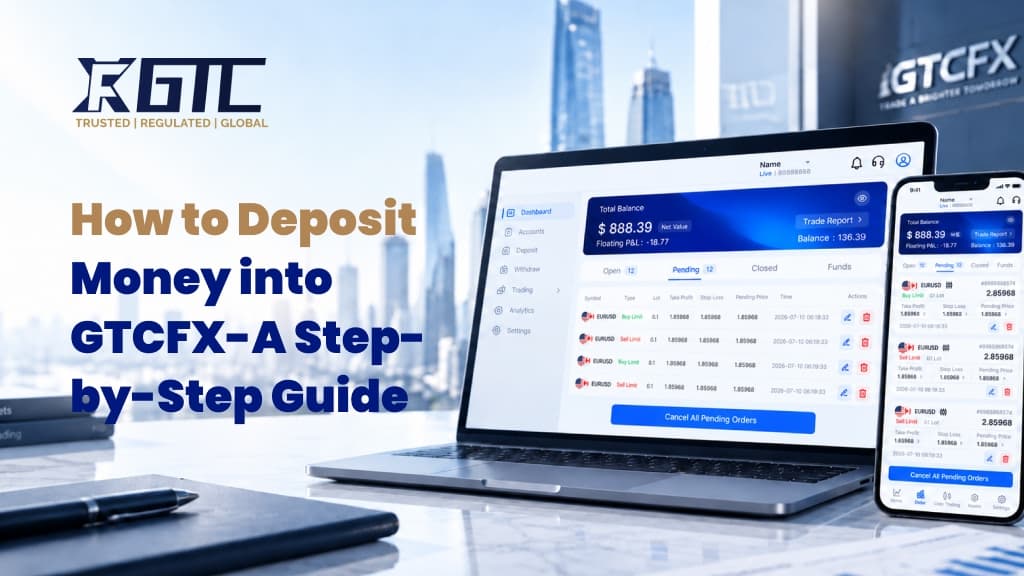
Depositing funds into your trading account is an essential step before you start trading with GTCFX. This guide explains how to deposit money into GTCFX, inclu…
OCT 14, 2026

Learn when the forex market opens and closes, how Sydney, Tokyo, London and New York sessions work, and how overlaps, DST and holidays affect trading activity.
SEP 18, 2026
-Open Your Account in Minutes-
Get instant access to global markets, advanced charting, and expert insights. Whether you're a beginner or a professional, your next opportunity starts here. Secure, regulated, and transparent.