



How to Make a Forex Withdrawal on GTC Go (GTCFX Guide)?
GTC Go is GTCFX's mobile trading app, giving traders quick access to accounts, markets, and fund management. As a regulated forex broker, GTCFX aims to make ev…
OCT 15, 2026
00
Blogs
Last updated: august 13, 2026 at 1:33 pm
Forex Liquidity Distribution : Roles & Principles Explained For Trading
According to the research team GTCFX, the role and principles of liquidity distribution in forex are the hidden engine that makes the global FX market function 24/5.
When traders understand how liquidity moves, who controls it, and where it concentrates, they stop chasing random price swings and start reading the true “order flow story” behind every candle.
In simple terms, liquidity in forex is how easily a currency pair can be bought or sold without causing a large change in its price.
Liquidity distribution describes where that liquidity actually sits in the market structure — across price levels, sessions, instruments, and participant types.
Liquidity in forex Trading is the ability to execute large buy or sell orders quickly, at or near the quoted price, without causing a big price impact.
In major pairs like EUR/USD or GBP/USD, there are so many buyers and sellers that the market can absorb big orders smoothly, creating global forex liquidity.
The role of liquidity in forex is directly tied to price stability and trading efficiency:
This is why professional desks closely monitor:
Volume and liquidity are closely related but not identical.
For traders, this means a spike in volume does not always mean a safe, liquid environment.
The volume and liquidity relationship must be analyzed together with spreads, volatility, and visible order flow.
Forex is an over-the-counter (OTC) market, so there is no single centralized liquidity pool.
Instead, forex liquidity structure is built from many layers of participants:
All of these create a dynamic web of quotes, orders, and hedging activity that forms global forex liquidity.
In practice, traders interact with several types of liquidity in forex:
Interbank and institutional flow dominate market liquidity in forex, while retail liquidity slightly “shapes” intraday patterns, especially around popular levels.
Market maker liquidity comes from entities willing to quote both a bid and ask price continuously, even when natural buyers or sellers are scarce.
Electronic Communication Networks (ECNs) and aggregators combine quotes from many liquidity providers to build a deeper, more competitive book.
This process underpins:
Retail and institutional traders interact with liquidity very differently:
Understanding retail vs institutional liquidity in forex helps explain why price often sweeps obvious retail levels before reversing — large players need to access hidden pools of liquidity to execute size.
From the perspective of GTCFX analysts, several forex liquidity principles guide how liquidity is distributed across the market:
These principles of liquidity in forex trading explain why price behaves differently in Asia vs London, or before vs after major economic releases.
Price discovery in forex is the process by which the market finds a fair exchange rate based on all available buy and sell orders.
Liquidity providers constantly update their bids and offers as new information and orders arrive.
This process creates liquidity pools — price areas where many resting orders are stacked:
Liquidity pools forex explained simply:
They are like reservoirs of pending orders that big players can tap into when they need to fill large positions without causing extreme slippage.
A liquidity imbalance in forex happens when aggressive buying or selling overwhelms available orders at a price level.
Price then jumps quickly to the next pocket of available liquidity, often forming sharp wicks or gaps.
This can lead to:
Traders often interpret these patterns as:
Liquidity zones forex are price areas with historically high traded volume or dense clusters of pending orders.
They often overlap with—but are not identical to—classical supply and demand zones.
Key differences:
The most powerful zones usually combine:
“Smart money concepts liquidity” is a popular way to describe how large institutions navigate liquidity.
Instead of chasing price, they:
This institutional order flow is what many price action and order flow liquidity traders try to follow.
Their goal is to align with smart money liquidity forex, not fight it.
The GTCFX research and expert team recommends a structured checklist for identifying liquidity levels in forex charts:
These steps reveal a forex liquidity distribution pattern for each pair, showing where price is likely to accelerate or reverse.
A liquidity sweep strategy forex tries to trade after the market has cleared obvious liquidity pools.
Typically, the sequence looks like this:
Traders then:
Some practical liquidity-based trading strategies forex traders can explore include:
Large banks are still the backbone of global forex liquidity.
They:
This behavior explains why spreads widen ahead of big news and thin again once uncertainty falls.
Market makers and liquidity providers use liquidity engineering forex to manage risk:
For traders, understanding this dynamic:
This guide turns abstract liquidity concepts into a practical map of how forex market liquidity distribution really works day to day.
By linking liquidity zones, liquidity pools, smart money behavior, and liquidity-based strategies, it helps traders move from guessing to interpreting price action with purpose.
The GTCFX team views the role and principles of liquidity distribution in Forex as a cornerstone topic for any serious trader. Once you understand who provides liquidity, how it is distributed, and why price seeks liquidity pools, every chart becomes a clearer narrative instead of random noise.
Mastering these forex liquidity principles will not turn every trade into a winner, but it will dramatically improve how you time entries, manage risk, and interpret institutional order flow.
In a market dominated by smart money and global banks, your edge comes from reading liquidity, not fighting it. Understanding concepts such as liquidity distribution, the role of liquidity providers, and identifying liquidity gaps is essential for any serious trader. If you're looking to optimise your broker connections, here's a guide on how to choose the right liquidity provider.
Also, for weekly market insights, you can explore our GTCFX to see the key events that shaped liquidity shifts last week.
1. What is liquidity in forex in simple words?
Liquidity in forex means how easily you can buy or sell a currency pair without causing a big price change.
If a market is very liquid, you can enter and exit trades quickly at prices close to what you see on the screen.
2. Why does liquidity matter in forex more than in many other markets?
Forex is a global, 24-hour market with huge daily turnover, so liquidity determines spreads, execution speed, and slippage.
Without deep liquidity, even small news events could cause massive, uncontrollable price gaps and make risk management almost impossible.
3. How does liquidity distribution affect forex price movement?
Price tends to move from one liquidity pool to another, clearing clusters of orders along the way.
That is why you often see price spikes through obvious highs or lows, trigger stops, and then reverse once that liquidity has been used.
4. What are liquidity zones in forex and how can I find them?
Liquidity zones are price ranges where many orders have been or are likely to be placed, such as previous highs/lows, ranges, and round numbers.
You can spot them by marking repeated reaction levels, equal highs/lows, and areas where price has spent a lot of time with high volume.
5. What is the difference between liquidity zones and supply and demand zones?
Supply and demand zones focus on where price strongly reversed before, showing imbalances between buyers and sellers.
Liquidity zones focus on where orders currently cluster, especially stops and pending orders, which may or may not align with old reversal zones.
6. Are liquidity sweeps and stop hunts always manipulation?
Many so-called “stop hunts” are simply large players needing to access enough opposite orders to fill a position, which naturally drives price into stop-heavy areas.
7. How can beginners safely apply liquidity-based trading strategies?
Start by mapping simple liquidity zones on higher timeframes and noting how price behaves when these levels are approached and broken.
Avoid trading right into obvious liquidity pools and instead look for confirmation after sweeps or clear break-and-retest setups.
8. What tools can help me see forex liquidity structure more clearly?
Depth-of-market, Level 2 data, and volume indicators can reveal some of the liquidity picture, especially on institutional platforms.
Even without these, careful analysis of highs, lows, ranges, and session opens can give a surprisingly accurate view of liquidity distribution on your charts.
Add as a preferred source on Google
GTC Go is GTCFX's mobile trading app, giving traders quick access to accounts, markets, and fund management. As a regulated forex broker, GTCFX aims to make ev…
OCT 15, 2026
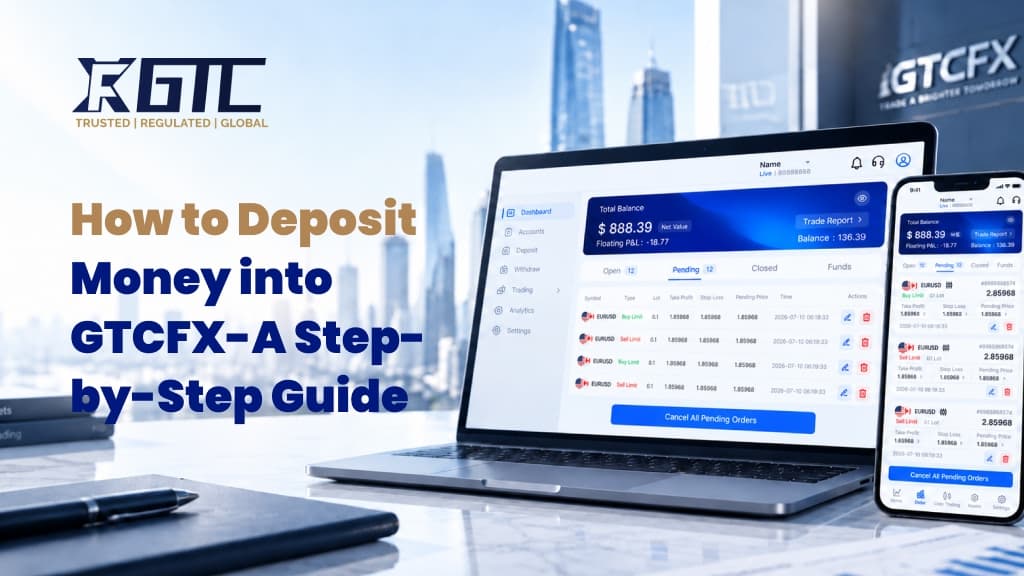
Depositing funds into your trading account is an essential step before you start trading with GTCFX. This guide explains how to deposit money into GTCFX, inclu…
OCT 14, 2026

Learn when the forex market opens and closes, how Sydney, Tokyo, London and New York sessions work, and how overlaps, DST and holidays affect trading activity.
SEP 18, 2026
-Open Your Account in Minutes-
Get instant access to global markets, advanced charting, and expert insights. Whether you're a beginner or a professional, your next opportunity starts here. Secure, regulated, and transparent.