
The foreign exchange market stands as the world's largest and most liquid financial marketplace, trading trillions of dollars worth of different currencies every single day. For traders navigating this massive ecosystem, understanding forex liquidity isn't just beneficial—it's absolutely essential for success. Whether you're a beginner exploring currency pairs or an experienced trader refining your strategy, mastering liquidity in forex trading explained concepts will dramatically improve your trading outcomes.
Forex liquidity refers to the ease and efficiency with which a currency pair can be bought or sold without significantly affecting the market price. Think of it as the lifeblood pumping through the veins of the forex market—without adequate liquidity, the entire system would suffer from inefficiency, wider spreads, and poor price discovery. With deep liquidity across multi-asset instruments and advanced market depth technology, traders can experience optimal conditions to benefit from high liquidity environments.
In this comprehensive guide, we'll explore why forex liquidity matters, break down the various forex liquidity indicators and measurement tools, examine high liquidity currency pairs, and provide actionable strategies for analysing liquidity in forex for better entries.
What is Forex Liquidity?
Understanding what forex liquidity is forms the foundation of successful forex trading. In the simplest terms, forex market liquidity represents the readily available demand and supply for a currency pair—meaning currencies are abundantly available, and sufficient traders are willing to exchange them at any given moment.
The forex market enjoys exceptional liquidity primarily because of its:
- Massive daily trading volume exceeding $7.5 trillion in OTC transactions
- Decentralized global structure operating 24 hours across major financial centers
- Diverse participant base including central banks, financial institutions, hedge funds, and retail traders
- Continuous market accessibility allowing trading around the clock five days a week
When liquidity is high, orders execute seamlessly and quickly at prices close to market value, ensuring low spread ranges and minimum slippage. Conversely, markets with low liquidity suffer from long pending orders at rates differing from regular rates because there's insufficient demand for the currency pair.
Access to quality liquidity infrastructure enables traders to experience institutional-grade performance that enhances their trading experience significantly.
Importance of Liquidity in Forex
Understanding the importance of liquidity in forex helps traders appreciate why forex liquidity matters for their bottom line. Liquidity serves as the stabilising force that maintains market balance and ensures efficient price discovery.
Ensuring Fast Order Execution
Highly liquid markets deliver speedy order execution with minimal slippage—the difference between the desired price and the executed price. Forex execution speed directly impacts profitability, especially for scalpers and day traders, where milliseconds decide outcomes. Studies indicate that brokers with sub-100ms execution speeds can reduce effective spreads by approximately 20%.
Reduced Volatility and Price Stability
Markets backed by sufficient liquidity experience less volatile price swings, ensuring a stable price environment and minimizing investor losses. The relationship between forex liquidity vs volatility demonstrates an inverse correlation—high liquidity generally means lower volatility, while low liquidity contributes to higher volatility.
Tighter Spreads and Lower Transaction Costs
The bid ask spread in forex trading narrows significantly in liquid markets because more participants create competitive pricing. High liquidity reduces the gap between buy and sell prices, resulting in fair pricing for all market participants and lower overall trading costs. Premium trading platforms offer spreads starting from 0.0 pips on ECN accounts, demonstrating the benefits of deep liquidity pools.
Better Trade Entry and Exit Points
Analysing liquidity in forex for better entries allows traders to execute large positions without significantly impacting market prices. This capability proves particularly valuable when implementing precise entry strategies or managing substantial portfolios.
Key Factors Affecting Forex Liquidity
Multiple factors influence forex market liquidity, and understanding these helps traders anticipate market changes and adjust their strategies accordingly.
Market Size and Currency Pair Popularity
Market size remains one of the most critical factors affecting forex liquidity. Popular currencies like the US Dollar (USD), Euro (EUR), and Japanese Yen (JPY) maintain high liquidity due to their significant global demand and trading volume. EUR/USD represents approximately 24-30% of all daily forex trades, making it the most liquid currency pair available.
Trading Sessions and Time Zones
Forex Trading liquidity during different sessions varies considerably based on which major financial centers operate simultaneously. The key sessions include:
- London Session (8:00 AM – 5:00 PM GMT): Handles approximately 37.8% of global FX volume with the highest liquidity
- New York Session (8:00 AM – 5:00 PM EST): Second most liquid session, particularly powerful during overlap with London
- Tokyo Session (12:00 AM – 9:00 AM GMT): Lower liquidity but significant for JPY pairs
- Sydney Session: Typically quietest with lower overall liquidity
The London-New York overlap (1:00 PM – 5:00 PM UTC) represents the absolute peak trading window, offering maximum liquidity and optimal trading conditions.
Economic Events and Monetary Policy
Central bank interventions, monetary policy announcements, and major economic releases significantly impact forex liquidity. During high-impact news events, liquidity can temporarily decrease as market makers widen spreads to protect against rapid price movements.
Geopolitical Developments
Political decisions, economic crises, and natural disasters influence market sentiment and consequently affect liquidity levels by either encouraging or discouraging trading activity.
How to Measure Forex Liquidity
Learning how to measure forex liquidity equips traders with the analytical tools needed for informed decision-making. Several forex liquidity metrics and indicators help quantify market liquidity levels.
Bid-Ask Spread Analysis
The bid ask spread in forex trading serves as one of the clearest and most accessible forex liquidity indicators. The spread represents the difference between the buying price (ask) and selling price (bid) of a currency pair.
Formula: Bid-Ask Spread = Ask Price – Bid Price
- Narrow spreads (typically 0.1-2 pips for major pairs) indicate high liquidity with many active participants
- Wide spreads (often 5+ pips) suggest lower liquidity, higher risk, and increased trading costs
For example, EUR/USD typically maintains spreads around 0.1-0.6 pips during peak hours due to its exceptional liquidity, while exotic pairs may see spreads exceeding 10 pips.
Forex Volume Analysis
Forex volume represents the number of active transactions occurring between buyers and sellers. High forex volume and liquidity share a strong positive correlation—increased volume indicates more trading activity and greater market efficiency.
Traders can analyze liquidity by:
- Tracking current trading volumes for specific currency pairs
- Comparing current volumes against historical data
- Identifying patterns in volume changes during different sessions
- Noting volume spikes around economic releases
In April 2023, daily OTC forex transactions averaged $918.4 billion, reflecting the market's extraordinary liquidity levels.
Market Depth and Order Book Liquidity
Market depth forex trading refers to the number of placed orders—specifically pending buy and sell orders—in the market. Order book liquidity provides crucial insights into how many traders are waiting to exchange at various price levels.
Premium trading platforms provide up to 10 levels of market depth, enabling traders to visualise liquidity distribution across price levels and make better-informed decisions.
Price Action Analysis
Price action serves as an excellent practical measure of liquidity. A stable market with consistent pricing signifies adequate liquidity, while currency pairs exhibiting high price volatility typically indicate lower liquidity levels.
Key price action indicators:
- Smooth, gradual price movements suggest high liquidity
- Erratic, gapping price movements indicate liquidity concerns
- Consistent candle formations reflect stable market conditions
Liquidity Ratios
Forex liquidity measurement tools include various financial ratios that traders use to quantify liquidity mathematically. Common ratios include:
- Turnover ratios measure trading activity
- Current ratios assess overall market health
- Quick ratios evaluate immediate liquidity availability
- Cash ratios examine readily convertible assets
High Liquidity vs Low Liquidity Currency Pairs
Understanding the difference between high and low liquidity in forex helps traders select appropriate currency pairs for their strategies and risk tolerance.
High Liquidity Currency Pairs
High liquidity currency pairs represent the most traded forex trading pairs globally, offering optimal trading conditions:
These major pairs benefit from tight spreads, fast execution, and reduced slippage—ideal for traders seeking predictable trading conditions.
Low Liquidity Currency Pairs
Exotic currency pairs involving emerging market currencies exhibit lower liquidity characteristics:
- Wider spreads increase transaction costs
- Higher volatility creates both risk and opportunity
- Slower execution potentially causing slippage
- Greater sensitivity to local economic/political events
Examples include USD/TRY, USD/MXN, and other pairs involving currencies from developing economies.
Role of Liquidity Providers in Forex
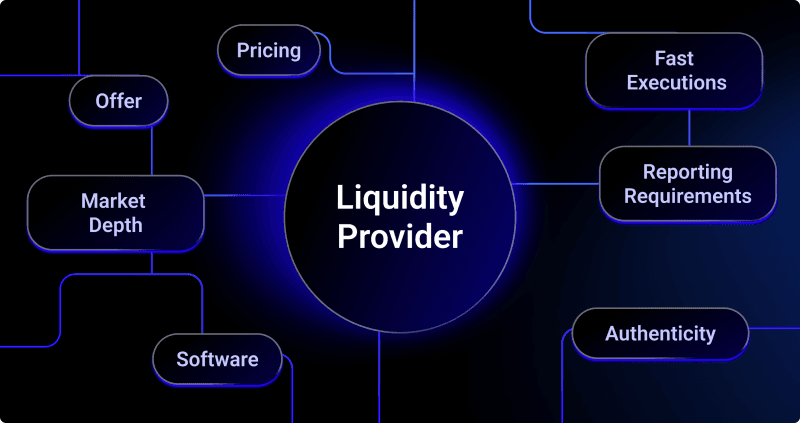
Liquidity providers in forex form the backbone of market efficiency by ensuring the continuous availability of currency for trading.
Market Makers and Their Functions
Market makers, liquidity providers, continuously quote buy and sell prices for currency pairs, acting as both buyer and seller to facilitate smooth market operations. Major institutional liquidity forex providers include:
- Deutsche Bank – Largest forex liquidity provider globally
- UBS, Barclays Capital, Citigroup – Top-tier institutional providers
- JP Morgan, Goldman Sachs – Influential market makers affecting entire sectors
How Liquidity Providers Benefit Forex Traders
Liquidity providers in forex deliver several crucial advantages:
- Continuous price availability ensures trades execute any time
- Competitive pricing through aggregated multi-source quotes
- Reduced spreads via institutional competition
- Market stability by absorbing large orders without price disruption
Professional trading platforms connect traders directly to Tier-1 banks and top liquidity providers, ensuring institutional-grade pricing and execution quality.
How Liquidity Affects Forex Trading Spreads and Trading Conditions
How liquidity affects forex trading spreads directly impacts every trader's profitability and forex trading conditions.
The Spread-Liquidity Relationship
Higher liquidity consistently correlates with tighter spreads because increased competition among market participants drives more competitive pricing. During peak liquidity hours (London-New York overlap), major pairs may see spreads as low as 0.1 pips, while the same pairs during low-liquidity periods (Sydney session) might experience spreads 2-3 times wider.
Slippage and Execution Quality
Slippage in forex trading occurs when orders execute at prices different from expectations. High liquidity environments minimise slippage by ensuring:
- Faster order execution (sub-100ms ideal)
- More available counterparties at desired prices
- Reduced price gaps between quotes
A 50ms execution during normal conditions might produce 0.5-pip slippage, while a 500ms execution could result in 2+ pips slippage—a significant difference for active traders.
Liquidity Forex Strategies
Effective liquidity trading strategies involve:
- Trading during high-liquidity sessions for tighter spreads and better execution
- Avoiding low-liquidity periods (holidays, session transitions) when spreads widen
- Using limit orders instead of market orders to control entry prices
- Monitoring liquidity zones for strategic entries and exits
Forex Liquidity Analysis for Better Trade Entries
Forex liquidity analysis empowers traders to identify optimal entry points and improve overall trading performance.
Identifying Liquidity Zones
Liquidity zones represent areas with high concentrations of trading activity—typically around historical support and resistance levels where many pending orders accumulate. These zones often:
- Act as magnets for future price action
- Provide reference points for entries and exits
- Signal potential reversal or breakout areas
Using Volume Profile for Liquidity Mapping
The volume profile tool displays trading volume across price levels rather than over time, helping identify where bulk trading activity has occurred. Areas with volume peaks indicate significant liquidity, guiding traders toward levels with optimal execution conditions.
Practical Entry Strategy Considerations
When analysing liquidity in forex for better entries:
- Mark key support/resistance levels where stop-loss orders are likely to concentrate
- Monitor candlestick patterns near liquidity zones for entry signals
- Wait for confirmation before executing trades at identified levels
- Set appropriate stop-losses beyond liquidity grab wicks
Conclusion
Understanding why forex liquidity matters and mastering how to measure forex liquidity represents fundamental knowledge every serious trader must possess. Liquidity serves as the invisible force enabling smooth market operations, competitive pricing, and efficient trade execution across the global forex marketplace.
Throughout this guide, we've explored forex liquidity indicators, high-liquidity currency pairs, and the crucial role of liquidity providers in trading. To dive deeper, check how liquidity is distributed , why liquidity providers matter, and how liquidity gaps affect price movement . If you're choosing a liquidity partner, see this guide. Explore more liquidity-focused resources on the GTCFX official site to enhance your trading performance.
Key takeaways for successful liquidity-aware trading:
- Trade during peak liquidity sessions (London-New York overlap) for optimal conditions
- Focus on major pairs like EUR/USD, USD/JPY, and GBP/USD for tighter spreads
- Monitor bid-ask spread in forex trading and market depth forex for liquidity assessment
- Use limit orders to minimise slippage during volatile periods
- Partner with brokers that offer deep institutional liquidity and forex access
Professional trading platforms stand committed to providing traders with exceptional liquidity solutions, including Tier-1 bank pricing, advanced execution technology, and transparent forex trading conditions. With spreads starting from 0.0 pips and up to 10 levels of market depth visibility, quality trading platforms empower traders to capitalise on high-liquidity environments for superior trading outcomes.
Whether you're measuring forex volume and liquidity, tracking forex liquidity during different sessions, or implementing liquidity trading strategies, the knowledge shared in this guide positions you for more informed, confident, and profitable forex trading decisions.
Frequently Asked Questions
Q1: What is forex liquidity, and why does it matter?
Forex liquidity refers to how easily currency pairs can be bought or sold without significantly impacting the market price. It matters because high liquidity ensures faster execution, tighter spreads, lower transaction costs, and reduced slippage—all crucial factors for profitable trading.
Q2: Which forex pairs have the highest liquidity?
EUR/USD holds the title of most liquid currency pair, comprising approximately 24-30% of daily forex trades. Other high liquidity currency pairs include USD/JPY (13.2%), GBP/USD (9.6%), USD/CHF, AUD/USD, and USD/CAD.
Q3: How do liquidity providers contribute to forex?
Liquidity providers in forex ensure market efficiency by continuously quoting buy/sell prices, maintaining tight spreads, absorbing large orders, and providing 24/7 market access. Top providers include Deutsche Bank, UBS, Barclays Capital, and Citigroup.
Q4: What are the best times to trade forex for maximum liquidity?
The London-New York overlap (1:00 PM – 5:00 PM UTC) offers peak liquidity with the tightest spreads and best execution. The London session independently handles approximately 37.8% of global forex volume, making it the most liquid session overall.
Q5: How does slippage relate to forex liquidity?
Slippage in forex trading increases when liquidity decreases because fewer counterparties are available at desired prices. High liquidity environments minimise slippage by ensuring faster execution and more available orders at each price level.
Q6: What is the difference between forex liquidity and volatility?
Forex liquidity vs volatility represents two distinct concepts: liquidity measures how easily assets can be traded without price impact, while volatility measures the magnitude of price fluctuations. Generally, high liquidity correlates with lower volatility, and low liquidity contributes to higher volatility.
Q7: How can I measure liquidity when trading forex?
Key forex liquidity metrics include bid-ask spreads (narrower = more liquid), trading volume (higher = more liquid), market depth/order book analysis, and price action stability. Tools like volume profile indicators help visualise liquidity distribution across price levels.
Q8: Why is liquidity so important for successful forex ?
Quality liquidity provides institutional-grade execution, competitive pricing, and reduced costs that directly impact profitability. Access to deep liquidity ensures faster order execution, minimal slippage, and the ability to trade larger positions without market impact.