Have you ever wondered how leverage can influence in the financial markets? The apparent amplification is due to one method called "leverage". However, what is leverage exactly? And how does it operate?
This article aims to give you information and knowledge, both for those who start off with little or no actual experience in financial trading as well as for those who would like to gain some additional information about using leverage effectively and how they can employ leverage when making financial investment decisions.
Furthermore, by the end of this article you should understand leverage as being an essential component of your financial investment portfolio.
What Is Leverage in Trading?
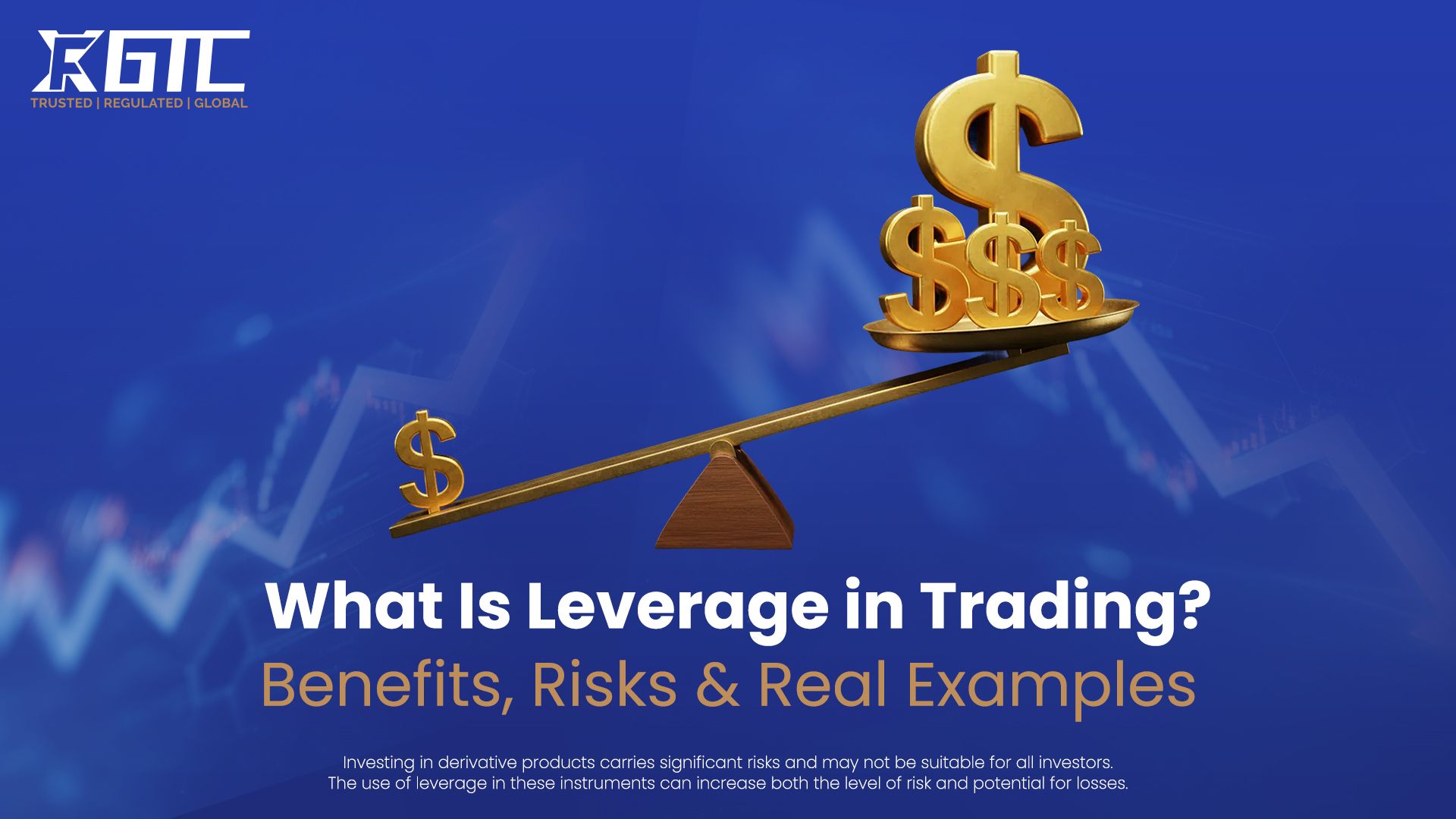
In the world of finance, leverage is the ability to use a fraction of your available capital to control a much larger amount of capital in a position. Leverage allows traders to gain larger market exposure by depositing margin, rather than paying the full position value upfront.
When a trader has access to a 10x leverage ratio, for instance, he can control $10,000 worth of a position with only $1,000 of his own capital. Leverage enables traders to take larger positions, potentially increasing their opportunities for profit compared to using only their own capital.
How Does Leverage Work?
Leverage allows traders to gain exposure to a larger market position by depositing only a portion of the total trade value, known as margin. In leveraged trading, the leverage ratio (for example, 10:1 or 50:1) represents the relationship between the required margin and the total position size. This means that a smaller initial deposit can provide exposure to a larger trade value than would otherwise be possible using only available capital. While leverage can increase potential returns, it can also magnify losses, and traders should carefully consider the risks involved before trading leveraged products.
Example of Leverage:
When trading forex, suppose you wish to purchase 100,000 units of a currency pair that your broker has given you fifty-to-one leverage against. You must deposit $2,000 with the broker, but he would lend you $98,000 if you did so.
Leverage Ratio
| Leverage Ratio |
Required Deposit |
Controlled Position |
| 10:1 |
$1,000 |
$10,000 |
| 50:1 |
$2,000 |
$100,000 |
| 100:1 |
$500 |
$50,000 |
Even small market movements may have a significant impact on leveraged positions.
Benefits of Leverage in Trading
-
Increased Profit Potential
Using leverage, traders can take control of larger positions than if they used only their capital, a process that increases the amount of money traders have available to potentially profit from their trades. For example, if a trader makes a profit of 1% on a position of $10,000 at 10 times leverage, that equates to a potential profit of 10% of his or her initial capital.
-
Access to More Markets
Leverage gives traders access to markets they might have otherwise been unable to trade in because of the capital needed to trade in those markets. Leverage allows traders to access markets with a smaller initial margin requirement, although this also increases risk exposure.
-
Capital Efficiency
When traders utilize leverage, they are able to hold more of their own equity in reserve and provide themselves with greater opportunities for diversification or capitalizing on other trades.
Risks of Leverage in Trading
Leverage can prove to be a very useful tool; however, there are also many additional risks associated with leveraging. Traders should never forget the following potential ways in which using leverage can prove detrimental to their portfolio.
-
Amplified Losses
Leverage works to amplify both gains and losses. A small percentage move against your position may result in very large losses (e.g., you could lose 20% of your investment from just a 2% loss on an individual trade).
-
Margin Calls
If account equity falls below the broker’s required margin level, the trader may receive a margin call or positions may be automatically closed. If the trader cannot satisfy the margin call, then their broker will implement their right to close the trade and secure the loss.
-
Emotional Impact
The potential for both profit and loss becomes emotionally charged and can lead to traders making emotionally charged decisions. An individual trader may feel compelled to trade too much or take on too much risk, which could cause the individual to make poor decisions and lose a significant amount of money.
Real Examples of Leverage in Trading
Example 1: Forex Trading with 100:1 Leverage
Let’s say that a trader has opened a long position in EUR/USD using his own capital of $1,000 plus leverage of 100 to 1. So, in this case, the trader will effectively control $100,000 worth of Euros vs US Dollars (100 times more than he has). A 0.50% increase in the value of the Euro vs the dollar would result in a profit of $500 to the trader. On the other hand, if the value of the Euro decreases by 0.50%, then the trader would lose $500 (50% of the original deposit).
Example 2: Stock Trading with 2:1 Leverage
When trading stocks, some brokers will provide a leverage to their clients at a 2:1 ratio. This means that when you put up $1,000 into a stock with a 2:1 leverage, you are controlling $2,000 worth of stock. If that stock increases in value by 5%, you will make $100 (5% of $2,000). On the other hand, if the price of that same stock drops by 5%, you will lose $100.
How to Use Leverage Safely?
- Know Your Risk Tolerance
You must make certain you are aware of your own tolerance for risk before using leverage. It’s important that you only use leverage for trading according to your own level of comfort with possible losses but also that you are utilizing an amount of leverage that aligns with your trading strategy.
- Use Stop-Loss Orders
Stop loss orders can be an effective way to limit losses in volatile markets. Utilizing stop loss orders, you can prevent further loss by automatically closing out a position.
- Begin with Low Amounts of Leverage
If you’re just getting started, you should use a low amount of leverage so you can learn to trade and develop an understanding of how the market operates. You can gradually increase your amount of leverage as you build your comfort level. Risk management tools and disciplined position sizing may help traders manage exposure when using leverage.
- Prioritize Learning
Educate yourself about how leverage works, different types of markets, and how leverage can affect both your potential gains and your losses while trading. Unlocking the full potential of using leverage begins with education and knowledge.
Conclusion
Leverage has the potential to enhance profit opportunities, but it also requires careful risk management and allow for larger contracts with a smaller amount of initial capital. But using leverage improperly can produce a great deal of risk in trading. To make the best of your experience with leverage while minimizing the risk associated with it requires understanding how leverage works, utilizing risk management tools and following a well-defined trading plan.
When trading currencies and CFDs, there is always a significant amount of risk. Because profits and losses are both magnified by the use of leverage, it is extremely important to fully comprehend the risks involved before engaging in forex and CFD trading.
Risk Disclaimer:
This content is for educational purposes only and does not constitute financial advice; trading involves significant risk, and you may lose your capital