When Does Forex Market Open?
2026 Update
Unlike traditional stock exchanges that operate during fixed local hours, the foreign exchange market follows a global network of financial centers that keeps trading active throughout the week.
QUICK GUIDE
Explore this article
+
💡 Key Takeaways
- The forex market operates 24 hours a day, five days a week, from Sunday evening to Friday afternoon because trading activity moves across global financial centers.
- The four major forex trading sessions are Sydney, Tokyo, London, and New York, each representing a key financial hub with different market characteristics.
- Forex liquidity often increases when major trading sessions overlap, especially during the London-New York overlap.
- Daylight Saving Time changes can shift displayed market hours depending on a trader's location and selected time zone.
- Regional holidays may reduce liquidity and affect spreads because fewer institutional participants are active in the market.
What Are the Major Forex Trading Sessions?
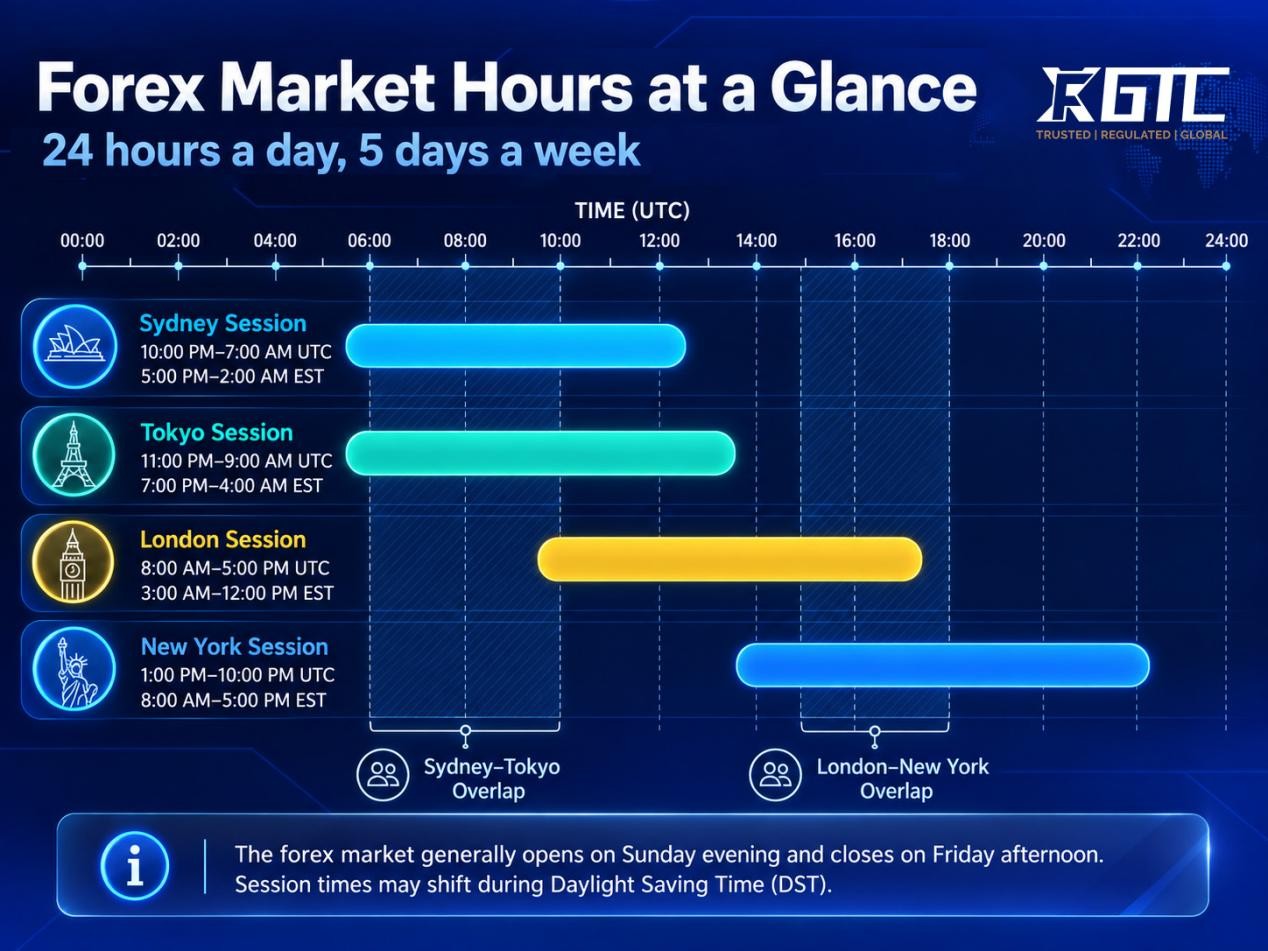
Unlike traditional stock exchanges that operate during fixed local hours, the foreign exchange market follows a global network of financial centers that keeps trading active throughout the week. The forex market generally opens on Sunday evening and closes on Friday afternoon, providing nearly continuous access across different time zones.
However, 24-hour availability does not mean market conditions remain the same throughout the day. Liquidity, volatility, and trading activity change as Sydney, Tokyo, London, and New York sessions open and close. So what to consider in forex trading? Keep scrolling.
The forex market is divided into four major trading sessions based on the world's leading financial centers: Sydney, Tokyo, London, and New York. Each session reflects regional market participation and may have different levels of liquidity, volatility, and currency focus.
Forex is a decentralized market, there is no single exchange that controls global opening and closing times. Instead, trading activity moves from one financial hub to another as the global trading day progresses.
Sydney Session
UTC 10:00 PM–7:00 AM · EST 5:00 PM–2:00 AM · Hub: Australia / New Zealand · Watched: AUD, NZD
Tokyo Session (Asian Session)
UTC 11:00 PM–9:00 AM · EST 7:00 PM–4:00 AM · Hub: Japan / Asia · Watched: JPY, AUD, NZD
London Session (European Session)
UTC 8:00 AM–5:00 PM · EST 3:00 AM–12:00 PM · Hub: United Kingdom / Europe · Watched: EUR, GBP, CHF
New York Session (North American Session)
UTC 1:00 PM–10:00 PM · EST 8:00 AM–5:00 PM · Hub: United States / North America · Watched: USD, CAD
Note: Forex session times may shift depending on Daylight Saving Time (DST) changes and the trader's selected time zone.
The London-New York Overlap (13:00–17:00 GMT)
The London-New York overlap is widely monitored because two of the largest forex markets operate simultaneously.
This period typically occurs around:
- 8:00 AM – 12:00 PM EST
- 1:00 PM – 5:00 PM GMT
During this overlap, liquidity often increases because European and North American participants are active at the same time. Major currency pairs, including EUR/USD and GBP/USD, may experience higher trading volume and more noticeable price movements.
Traders researching trading session times EST often pay attention to this period since it aligns with major US economic announcements and active European market hours.
However, increased activity does not automatically indicate favorable conditions for every strategy. Some traders prefer higher volatility, while others may focus on calmer market environments.
The Sydney-Tokyo Overlap (00:00–07:00 GMT)
The Sydney-Tokyo overlap represents the transition between Australian and Asian market activity.
During this period:
- AUD and NZD pairs may receive increased attention
- regional economic data can influence price movements
- liquidity may improve compared with the earlier Sydney session
Although this overlap generally has lower activity than the London-New York period, it can still be relevant for traders focusing on Asia-Pacific currencies.
Lower-Liquidity Periods
Some periods of the trading day experience lower participation because major financial centers are between sessions. Lower liquidity may affect:
- bid/ask spreads
- price movement patterns
- order execution conditions
For example, the period after New York closes and before Asian markets become fully active often sees reduced market participation.
Therefore, you should monitor these periods carefully, especially when trading strategies depend on short-term price movements.
How Do Daylight Saving Time and Holidays Affect Forex Trading Hours?
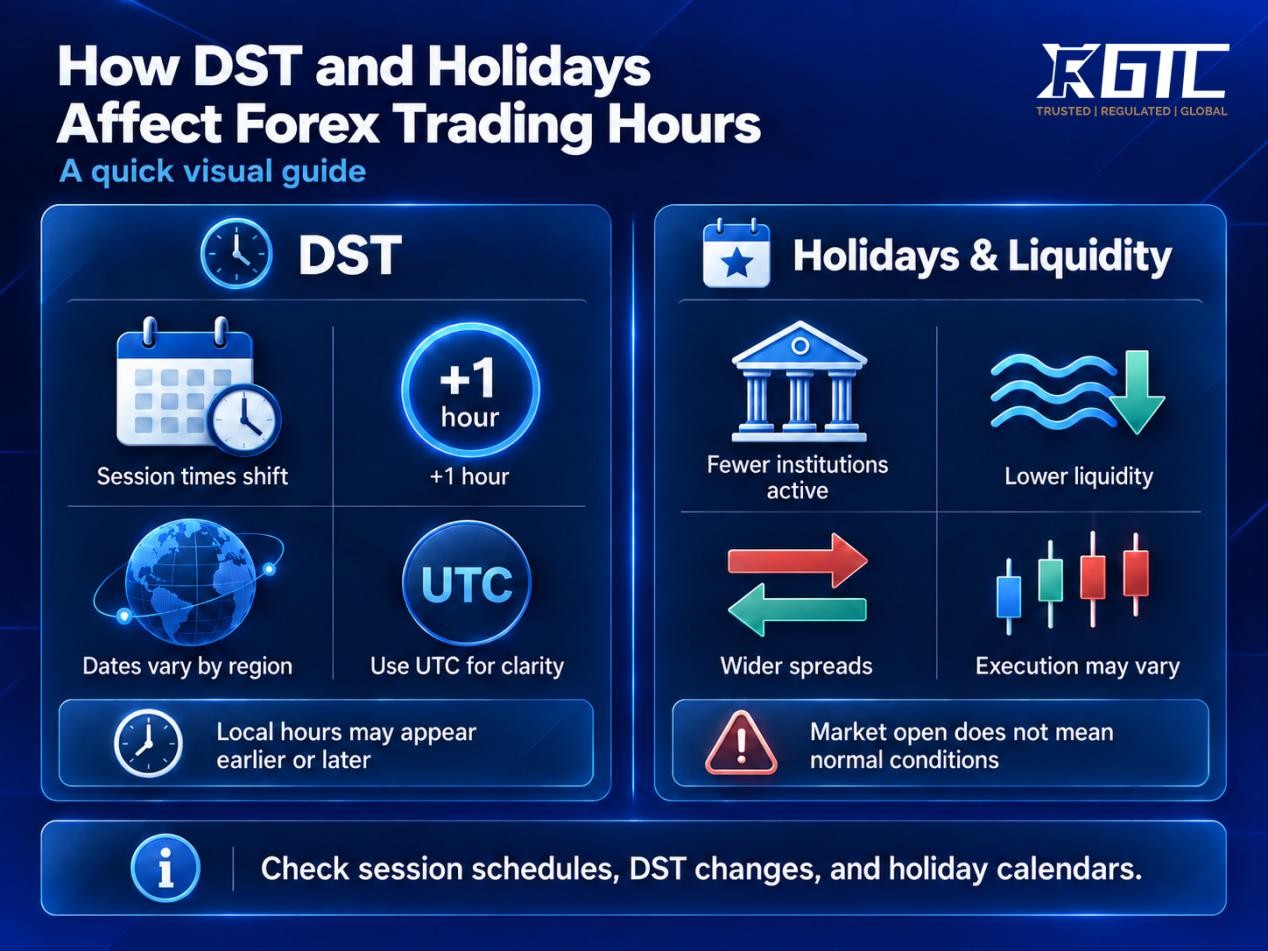
Forex trading hours are global, but displayed session times can change because, you know, countries follow different time zone rules. Holidays can also affect liquidity because fewer institutional participants may be active in the market.
The Global Impact of Daylight Saving Time (DST)
Daylight Saving Time creates seasonal changes in how trading hours appear across regions. While financial markets usually maintain their local operating schedules, the conversion between time zones can shift during DST transitions. For example:
- The United States and Europe do not switch to DST on the same date.
- Some countries, including Japan, China, Hong Kong, Singapore, and India, do not observe DST.
- The same forex session may appear one hour earlier or later depending on the trader's location.
These differences can affect traders who follow specific session schedules, economic releases, or automated trading systems. Professional trading systems often use Coordinated Universal Time (UTC) internally to reduce confusion caused by seasonal time changes.
Holiday Trading Liquidity and Spread Risks
Although the forex market does not completely close because of most regional holidays, liquidity can change when major financial institutions are unavailable. During holidays such as US or UK bank holidays:
- fewer institutional participants may be active
- trading volume can decrease
- spreads may become wider
- price movements may behave differently
For example, when US equity markets close during major federal holidays, broader market participation may also decline.
Traders should consider holiday schedules when evaluating market conditions, especially if their approach relies on short-term execution or high liquidity environments.
🏁 Conclusion
GTCFX provides access to global CFD markets, including forex, metals, indices, shares, and other instruments through platforms such as MT4, MT5, and GTC Go. You can explore available tools and market access options based on their own trading preferences and requirements.
Frequently Asked Questions
Can I Trade Forex on the Weekend?
The major forex market generally closes after Friday afternoon and reopens on Sunday evening when trading activity begins in Asia-Pacific markets.
During weekends, traditional forex liquidity is limited because major financial centers and institutional participants are not operating normally. Some other markets, such as cryptocurrencies, may follow different trading schedules.
Does My Broker's Server Time Zone Matter?
A broker's server time zone can affect how trading information appears on a platform, including daily candle charts, market sessions, and rollover calculations.
Traders using platforms such as MetaTrader 4 (MT4) and MetaTrader 5 (MT5) may review server time settings when analyzing charts or planning strategies. Understanding the displayed time zone can help traders interpret market data more consistently.
GTCFX provides access to MT4, MT5, and the GTC Go mobile trading app, allowing traders to monitor markets and manage their trading activities across different devices.
Which Days of the Week Are Historically More Active?
Market activity is often higher from Tuesday to Thursday because global markets have moved beyond the initial positioning period after the weekly open.
Monday may experience adjustments after weekend developments, while Friday afternoon often sees reduced liquidity as some participants reduce exposure before the weekend.
However, activity levels can change depending on economic releases, geopolitical events, and market conditions.
Risk Warning
This content is for educational purposes only and does not constitute financial advice. Trading involves significant risk, and you may lose your capital.
GTCFX operates as a multi-regulated group of companies. Clients are kindly advised to confirm the specific legal entity, regulation and jurisdiction under which they are being onboarded.