How to Trade Oil CFDs: A Step-by-Step Guide
for Beginners
Crude reaches retail traders through several very different instruments, and the differences matter more than they first appear.
QUICK GUIDE
Explore this article
+
What You Are Trading When You Trade Oil CFDs
Crude reaches retail traders through several very different instruments, and the differences matter more than they first appear.
Physical Crude
Holds: Actual barrels · Delivery risk: Yes · Typical minimum size: Cargo-scale
Futures Contract
Holds: Exchange contract with delivery terms · Delivery risk: Yes, if held to expiry · Typical minimum size: 1,000 barrels per contract
ETF or ETC
Holds: Fund units tracking oil · Delivery risk: No · Typical minimum size: One unit
CFD
Holds: Contract with your broker referencing the futures price · Delivery risk: No · Typical minimum size: Fractional lots
Retail traders mostly use CFDs for two practical reasons: no delivery obligation to manage, and positions sized far smaller than an exchange futures contract requires. The trade-off is that a CFD is a contract with your broker rather than an exchange-cleared instrument, so execution quality, financing costs and contract specifications vary by provider rather than being standardised.
What the ticker tracks deserves precision. An oil CFD does not track "the price of oil" in the abstract. It tracks a specific futures contract, for a specific benchmark, for a specific delivery month. That is why two oil instruments can show different prices at the same moment — they may reference different contract months. GTCFX, for instance, lists several distinct crude instruments alongside natural gas within its energy CFD range.
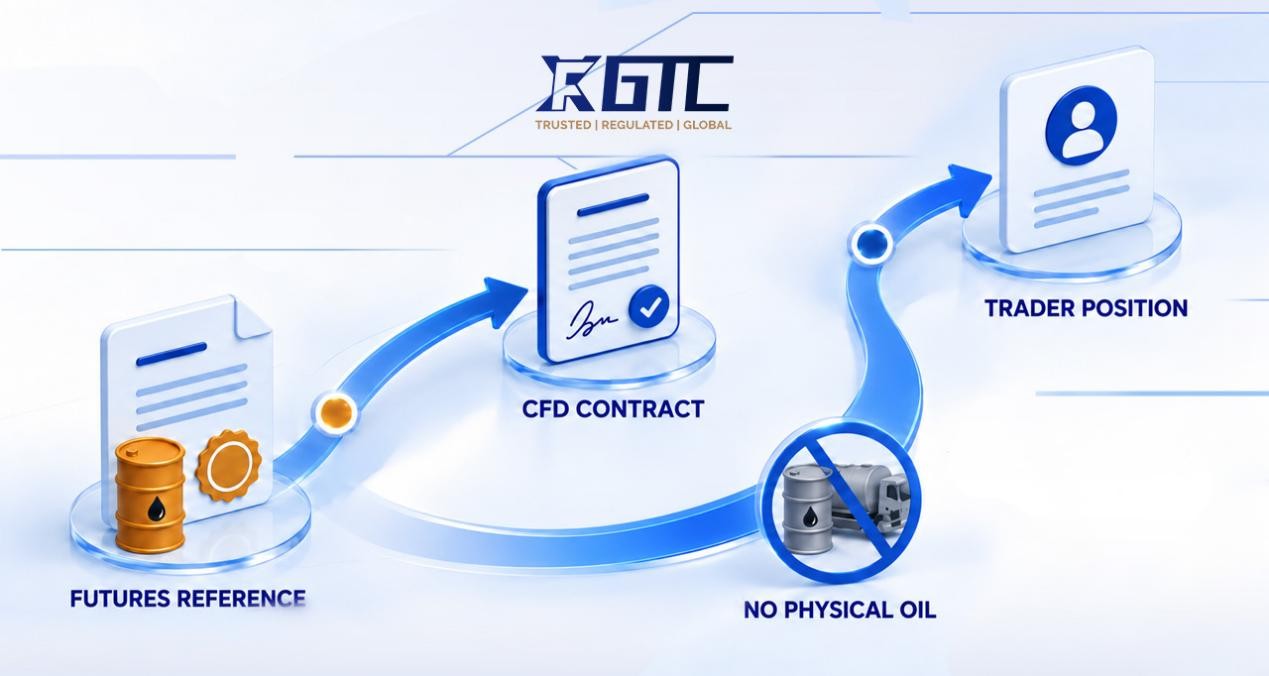
An oil CFD references a futures price, but the trader holds a contract with the provider rather than physical oil.
The two benchmarks you will encounter are Brent, a waterborne North Sea crude serving as the international reference, and WTI, produced onshore in the United States and priced at Cushing, Oklahoma.[2] They respond to different drivers and the gap between them carries information of its own; our detailed comparison of the two benchmarks covers how that gap behaves and what it signals.
What Moves Oil Prices
Supply. OPEC+ production decisions are the most-watched supply variable, because the group's collective policy can add or remove meaningful volume on a scheduled announcement. US shale output moves on a slower cycle but in larger cumulative amounts. Weekly US inventory data gives the most frequent available read on whether supply is building or drawing down, and it lands on a fixed schedule every oil trader knows.
Demand. Global growth data feeds demand expectations because industrial activity, freight and air travel all consume refined products. Demand is seasonal — northern-hemisphere summer driving and winter heating create predictable annual patterns — and refinery maintenance windows temporarily reduce crude intake regardless of end demand.
Geopolitics. Oil reprices on political headlines faster than almost any other instrument, because a meaningful share of global supply moves through a small number of maritime chokepoints.
The 2026 market shows all three at once. Following a US-Iran memorandum of understanding in June, Brent fell as low as $69 per barrel on 2 July. Renewed attacks on tankers transiting the Strait of Hormuz later that month cut shipments through the waterway, and Brent reached $105 on 23 July.[3] In its August outlook the EIA forecast Brent to average around $85 per barrel in the third quarter of 2026, falling to an average of $69 in 2027 as most disrupted production recovers, while still assuming roughly 0.6 million barrels per day of continued disruption through the end of 2027.[4]
The dollar link. Crude is priced in US dollars, so a stronger dollar makes oil more expensive for buyers holding other currencies and tends to weigh on demand. The relationship is real but loose — background force, not a standalone signal.
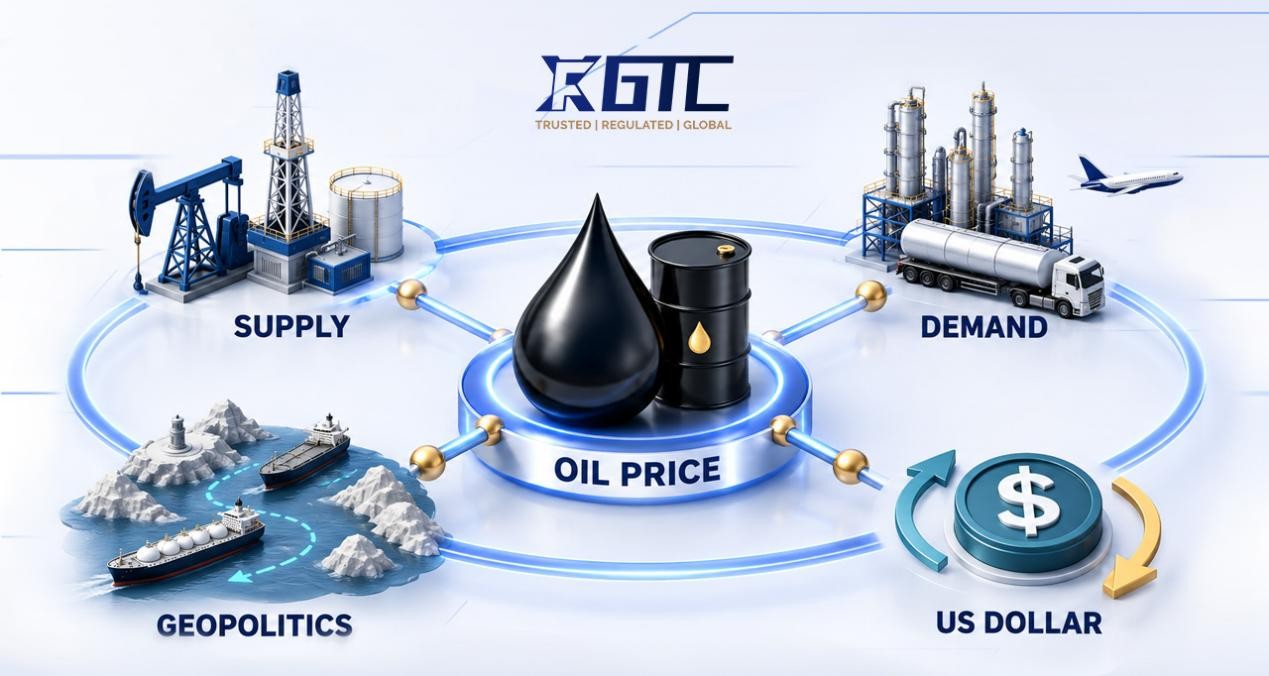
Oil prices respond to several forces at once: supply, demand, geopolitics and the US dollar relationship.
Reading an Oil Quote
Three numbers determine what a price move is worth to you.
Contract size. A standard oil lot conventionally represents 1,000 barrels, matching the underlying futures contract, and many brokers offer fractional lots. Confirm this on the contract specification page for your instrument rather than assuming, because it varies between providers.
Tick value. At 1,000 barrels per lot, a $1.00 move equals $1,000 per lot. Oil is normally quoted to two decimal places, making the minimum $0.01 increment worth $10 per lot.
Margin and leverage. The margin requirement determines how much capital is tied up. Note that leverage on energy instruments is frequently tiered rather than flat: GTCFX publishes a dynamic leverage schedule under which the maximum available leverage on crude oil applies to the first tier and reduces as position size increases.[1] Assuming the headline maximum applies to your whole position is a common and expensive error.
A worked example. You open one lot of WTI at $85.00 and close at $86.20. The move is $1.20, and at $1,000 per dollar per lot that is $1,200 gross. From that, subtract the spread paid at entry and any overnight financing if the position was held past settlement.
Overnight financing. Leveraged oil positions held past the daily settlement window incur a financing charge. On an intraday trade this is irrelevant; on a three-week hold it becomes a significant share of total cost, and it accrues whether the trade is winning or losing. Some providers also apply a multi-day financing charge on one weekday to account for the weekend — check which day applies to your instrument before building a strategy that holds through it.
Oil Trading Hours and Contract Expiry
When oil trades. Energy CFDs are typically available around 23 hours a day, Monday to Friday, subject to market conditions.[1] Availability is not liquidity: volume concentrates during the European-US overlap and thins in the late Asian session. Trading a thin window means wider spreads and a higher chance of slippage on both entry and stop.
Around inventory releases. Spreads widen and price can move sharply around scheduled inventory data. A stop placed close to price ahead of a release is likely to be triggered by the reaction rather than by any change in the trade's premise.
Expiry and rollover. Because an oil CFD references a dated futures contract, that contract eventually expires and the instrument rolls to the next month. Brokers handle this differently — some close and reopen at the new contract price with a cash adjustment, some adjust the position value directly — but the mechanics and the rollover date are disclosed in advance. The practical rule: if you hold oil for more than a few days, know your provider's rollover date and method before it surprises you.
Placing and Managing Your First Oil Trade
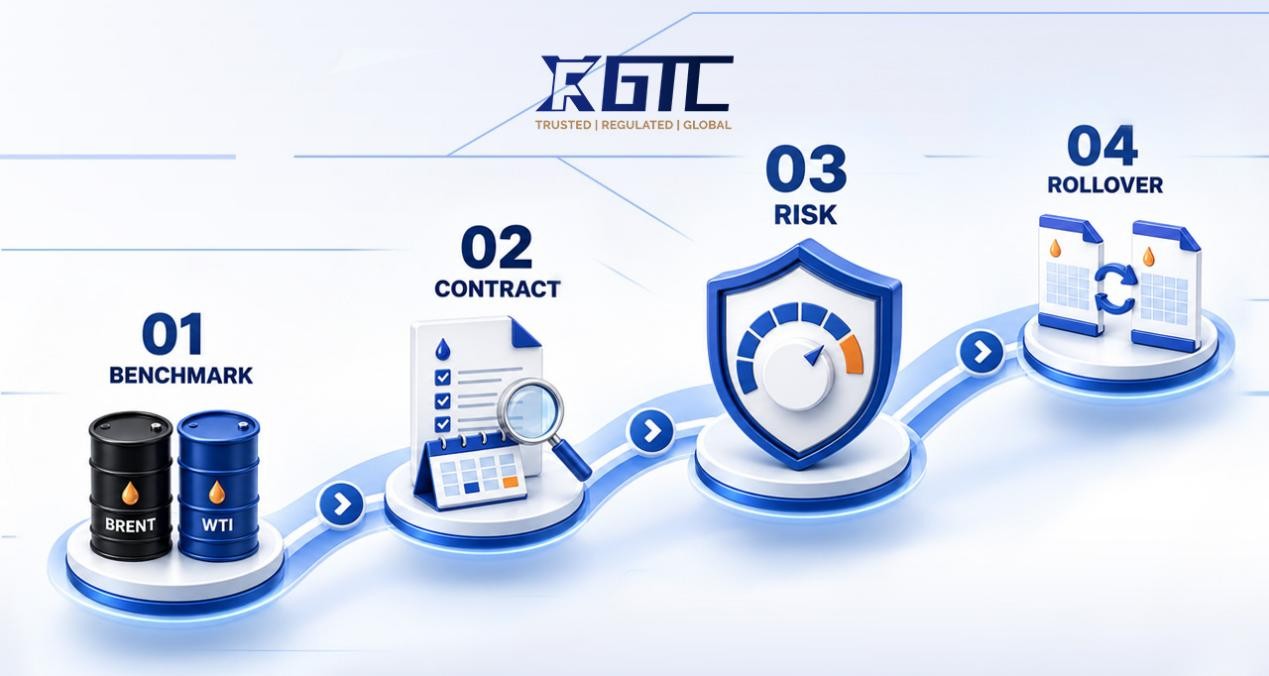
A practical oil CFD workflow starts with the benchmark and contract, then moves to risk sizing and rollover planning.
Build the trade before you place it
Decide direction and the reason for it, entry level, stop loss level and target. If you cannot state all four before opening, you do not have a trade — you have a guess with money attached.
Check the calendar first
Look at whether an inventory release, an OPEC+ meeting or major economic data falls inside your intended holding period. You may still want the trade, but choose that exposure deliberately.
Then size the position
This is where oil punishes habits formed on currency pairs. Work backwards: decide the maximum you are willing to lose on the trade, measure the distance from entry to stop, and let those two numbers determine size. If oil's ordinary daily range requires a stop $2.00 from entry, then at $1,000 per dollar per lot a full lot puts $2,000 at risk. If that exceeds what you are prepared to lose, the answer is a smaller position — not a tighter stop.
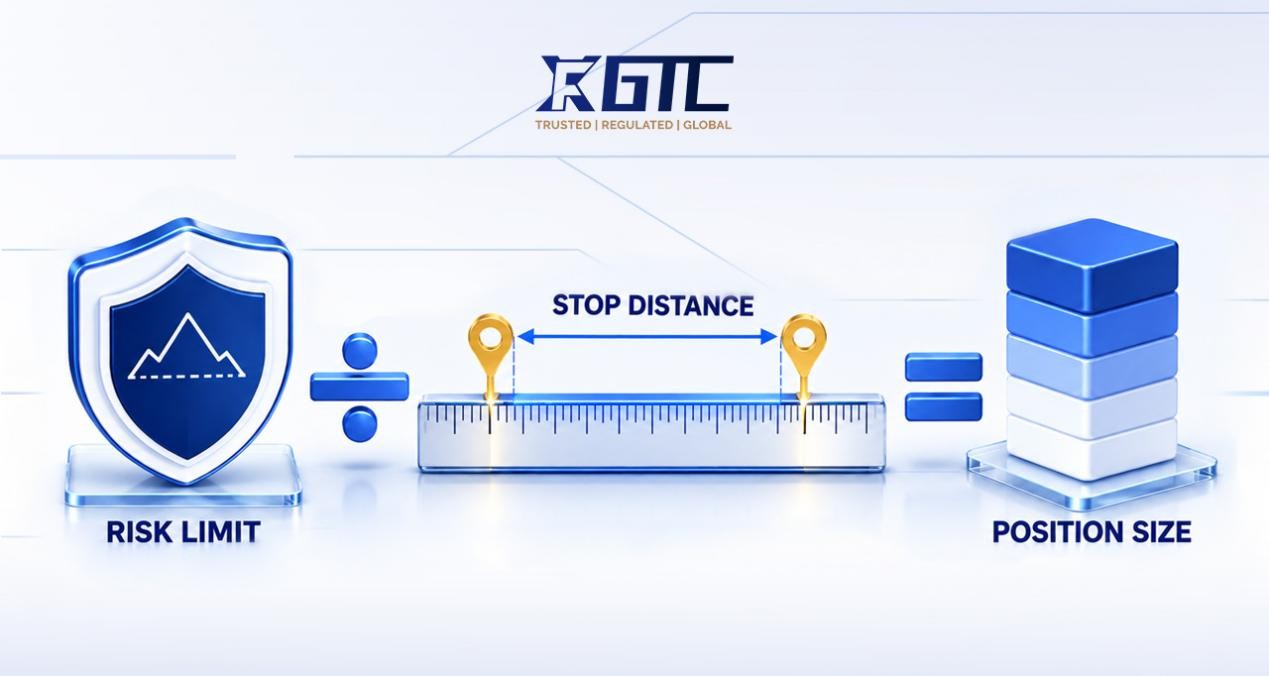
Position sizing works backwards from the loss limit: risk limit divided by stop distance determines the appropriate size.
Gap risk. Oil does not trade continuously. Positions held over a weekend, or through a scheduled OPEC+ announcement, can reopen at a materially different price, and a stop loss does not protect against a gap that jumps past it. Size accordingly, or close before the gap window.
The three mistakes that recur. Sizing oil like EUR/USD, producing positions several times too large for the instrument's range. Holding through an inventory release with no plan for either outcome. And widening a stop after the trade goes against you, converting a defined loss into an undefined one.
Getting Started with Oil at GTCFX
Both Brent and WTI are available as CFDs through MT4, MT5 and the GTC Go app. Before your first position, do three things.
Read the contract specification
Read the contract specification for the instrument you intend to trade, so you know contract size, tick value, margin requirement and rollover handling.
Check the daily range and stop cost
Check the current daily range and calculate what a sensible stop distance costs at the position size you have in mind.
Run it on a demo account first
Then run the whole process on a free demo account first, sized exactly as you intend to trade it live.
That last step is the one most often skipped, and the one that reveals whether your position sizing survives contact with oil's actual behaviour.
🔖 Summary
When you trade an oil CFD you take a position on a crude futures price without owning or receiving any oil.
Three things decide whether the trade works: understanding what moves the price, sizing the position for oil's daily range rather than a currency pair's, and knowing what happens when the underlying contract expires.
Frequently Asked Questions
How much capital do I need to trade one oil lot?
Margin on a full lot at recent price levels runs into the thousands of dollars, but margin is not the number that matters. What matters is whether your account can absorb the loss if the stop is hit — for a full lot with a $2.00 stop, that is $2,000. Most beginners should trade fractional lots.
What hours can you trade oil?
Around 23 hours a day, Monday to Friday, with a daily break and a weekend close. The liquid hours are the European-US overlap; late Asian hours are thin.
What happens if I hold an oil CFD past contract expiry?
It rolls to the next contract month according to your broker's published method, usually with a cash adjustment so the rollover itself is economically neutral. Know the date in advance.
Is oil suitable for beginners?
It is tradable by beginners who size correctly and respect the event calendar. It is unforgiving of anyone applying currency-pair position sizing to an instrument with several times the daily range.
Risk Warning
This content is for educational purposes only and does not constitute financial advice. Trading involves significant risk, and you may lose your capital.
GTCFX operates as a multi-regulated group of companies. Clients are kindly advised to confirm the specific legal entity, regulation and jurisdiction under which they are being onboarded.
Trading CFDs involves significant risk of loss and is not suitable for all investors. Prices and market conditions cited are as at the date of publication.