
Forex Spread Explained:
What You Actually Pay to Open, Hold and Close a Trade
What a forex spread is, how to convert it into money for your lot size, and what counts as a good spread. Plus the commission and swap costs that sit behind it.
QUICK GUIDEExplore this article+
Forex Spread Explained: What You Actually Pay to Open, Hold and Close a Trade
TL;DR — The spread is the gap between the price you can buy at and the price you can sell at, and you pay it on every trade. In money terms it is (spread in pips) x (pip value for your lot size). On top of it sit commission, overnight financing and a handful of charges that never appear in the quote. Which of these dominates depends entirely on how long you hold positions.
What Is a Spread in Forex Trading?
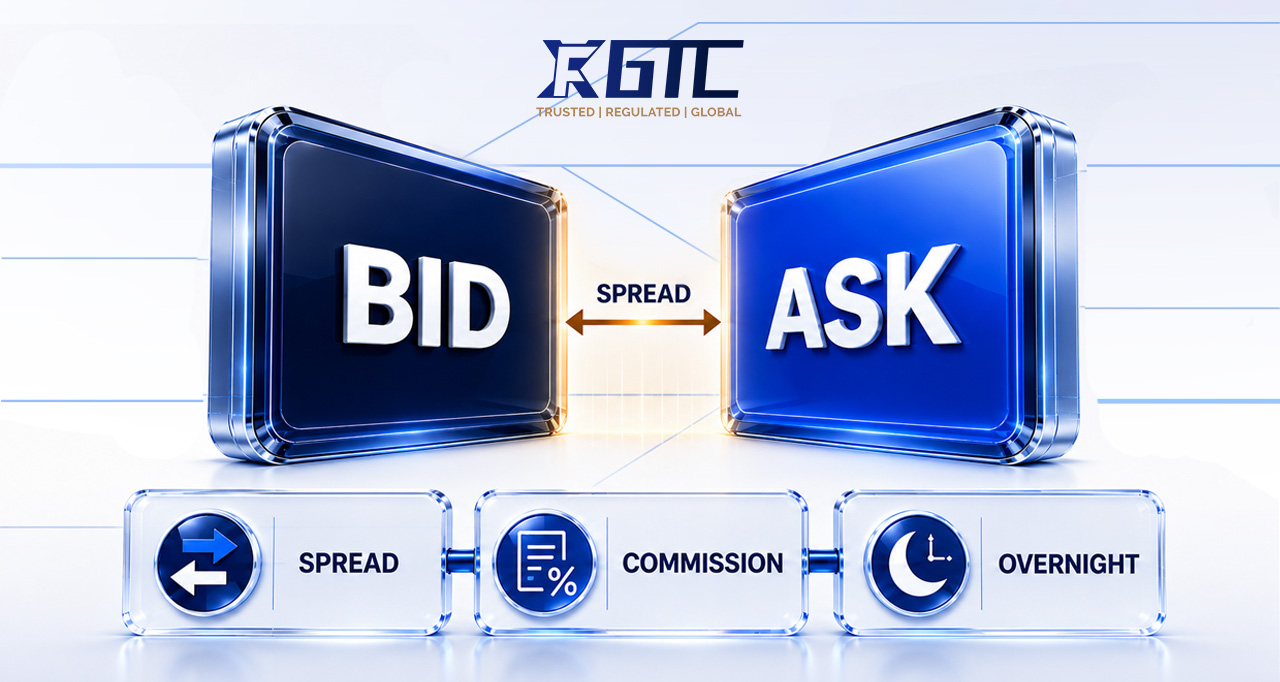
The spread is the difference between the bid price and the ask price — between what you can sell at and what you can buy at, at the same moment, on the same instrument.
That gap has an immediate consequence: a position opens at a small unrealised loss. If you buy at the ask and the market does not move, you can only close at the bid, which is lower. Before the trade makes anything, price has to travel the width of the spread just to reach break-even.
The spread is a cost of doing business rather than a fee levied by anyone in particular. It exists because someone must stand ready to take the other side of your trade, and that party prices in both the risk of holding the position and their own margin. Which is also why a "commission-free" account is not free. The cost has been moved into the spread, not removed. GTCFX's published forex account types illustrate how the balance between spread and separate commission can differ from one account structure to another.[2]
Bid, Ask and How to Calculate the Spread
Reading a quote. A quote shows two prices: bid on the left, ask on the right. If EUR/USD shows 1.08421 / 1.08433, you sell at 1.08421 and buy at 1.08433. The difference is 0.00012 — on a pair quoted to five decimal places, 1.2 pips.
Turning pips into money. Two steps:
Find the pip value for your position size. On a standard lot of 100,000 units of a USD-quoted pair, one pip is worth $10. On a mini lot (10,000 units), $1. On a micro lot (1,000 units), $0.10.
Multiply the spread in pips by that pip value.
A 1.2 pip spread on one standard lot of EUR/USD costs $12 to enter. On a micro lot, $0.12.
The spread is the measured gap between bid and ask; commission and overnight financing can add separate cost layers.
The same calculation on other instruments. This is where traders get caught out, because a pip is not a fixed amount of money across instruments.
| Instrument | Spread | Position size | Approximate cost |
|---|---|---|---|
| EUR/USD | 1.2 pips | 1 standard lot | $12 |
| EUR/USD | 1.2 pips | 1 micro lot | $0.12 |
| Gold (XAU/USD) | $0.30 | 1 lot (100 oz) | $30 |
| Index CFD | 1.0 point | 1 contract at $1/point | $1 |
The figures above are illustrative rather than quoted prices. The point is that identical-looking spread numbers on different instruments represent very different amounts of money, and the only way to know what you are paying is to run the conversion for the instrument and size you actually trade.
Fixed vs floating. A fixed spread stays constant under normal conditions; a floating spread moves with market liquidity. Most retail accounts today use floating spreads, usually tighter than fixed spreads in liquid conditions and wider when liquidity thins.
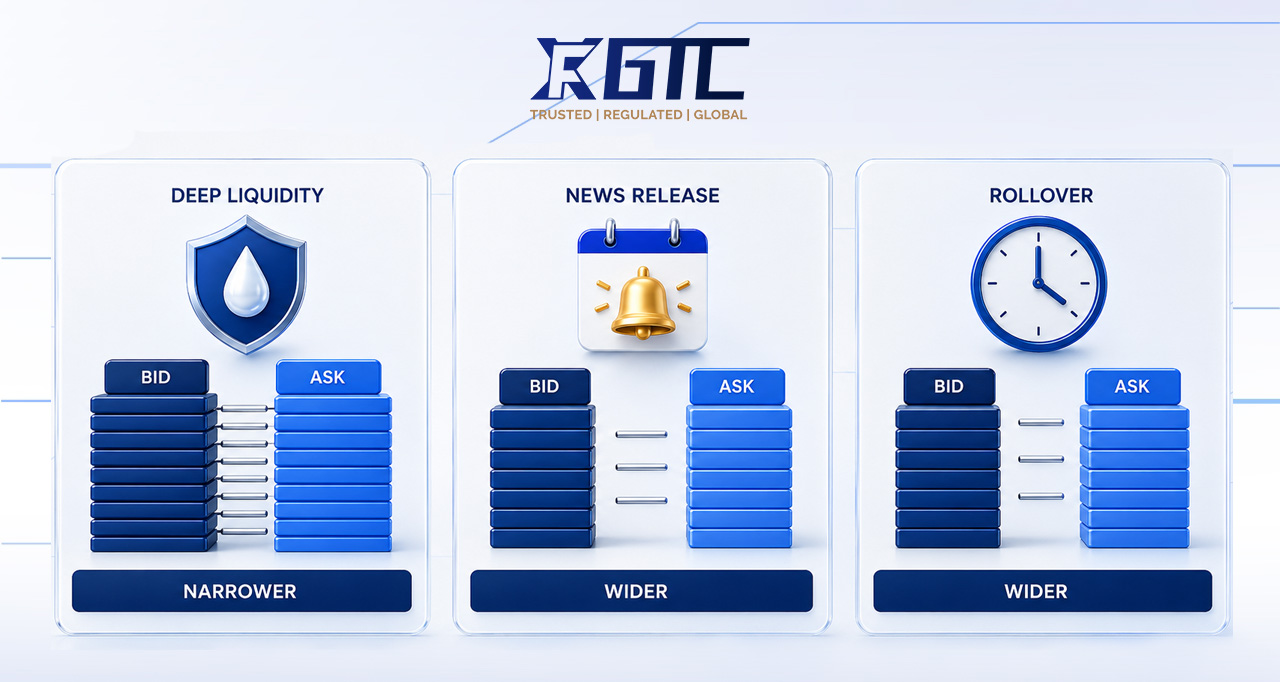
When spreads widen. Two predictable situations. Around scheduled news releases, liquidity providers pull back ahead of the announcement and spreads widen for a period around it. And at the daily rollover, when the trading day rolls to the next settlement date, spreads widen briefly during the changeover. Neither is a malfunction, and both are avoidable if you know the schedule.
Deep liquidity tends to compress the bid–ask gap; scheduled news and the daily rollover can temporarily widen it.
What Is a Good Spread?
The direct answer. For a major currency pair in liquid hours, a competitive spread is under 1 pip on a raw-spread account before commission, or roughly 1 to 1.5 pips on an all-in spread account. Minor pairs typically run several times wider than majors. Gold and index CFDs are quoted in their own units and must be converted before they can be compared to anything.
| Instrument type | Typical competitive range, liquid hours |
|---|---|
| Major currency pairs | Under 1 pip raw, or around 1–1.5 pips all-in |
| Minor currency pairs | Several times the major-pair spread |
| Exotic pairs | Substantially wider again, and less stable |
| Gold | Quoted in dollars per ounce; convert before comparing |
| Major index CFDs | Quoted in index points; convert before comparing |
Why the raw number means nothing on its own. A 0.2 pip spread on an account charging $7 per lot round-turn in commission is more expensive than a 0.8 pip all-in spread. Comparing spread figures across different account structures without adding commission back in produces the wrong answer every time.
Advertised vs actual. Brokers advertise "spreads from" a given figure. That is the best case — tightest instrument, deepest liquidity, calmest moment. The number that matters is the average spread on the instruments you trade, during the hours you trade them. Where a broker publishes live or average pricing, use that: GTCFX, for example, maintains a live spread and daily swap rate table covering forex, metals, indices and crypto, updated daily.[1] Check it at your own trading hours rather than during the London-New York overlap if that is not when you trade.
Beyond the Spread: Commission and Overnight Financing
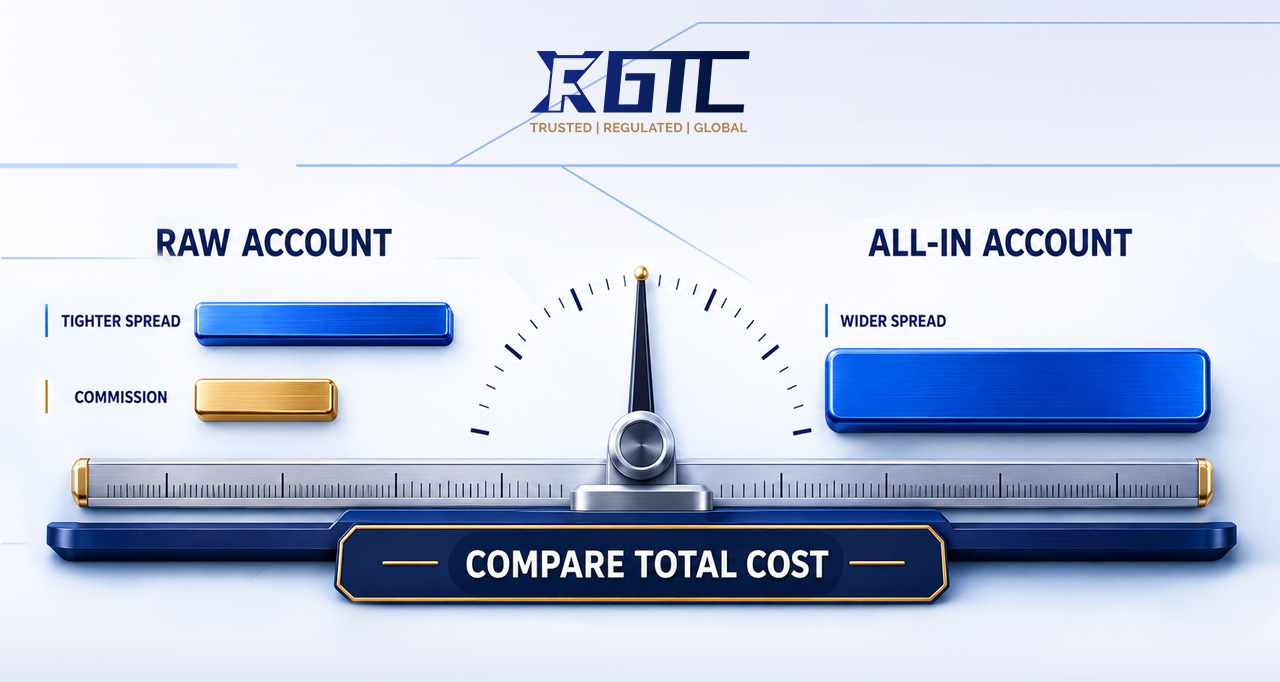
Two account structures. Raw-spread accounts pass through a near-interbank spread and charge a separate commission. All-in accounts fold the cost into a wider spread with no commission line. Neither is inherently cheaper; compare the spread and round-turn commission together at your own typical trade size.
Commission is charged per side. A quoted commission is usually per lot per side, so a stated $3.50 means $7.00 round-turn on a standard lot. Always work with the round-turn figure when comparing.
A raw account separates a tighter spread from commission; an all-in account embeds more of the cost in the spread. Compare the total.
The break-even comparison. Suppose a raw account offers 0.2 pips plus $7 round-turn, and an all-in account offers 1.0 pips flat. On one standard lot the raw account costs $2 of spread plus $7 of commission, so $9; the all-in account costs $10. The raw account wins — but the margin is thin, and it reverses at smaller position sizes, because commission is fixed per lot while spread scales with size. Run the arithmetic at your own typical trade size rather than accepting a general claim about which structure is better.
What a swap is. Holding a leveraged position past the daily settlement point means holding it overnight, which incurs a financing charge or credit. The rate derives from the interest rate differential between the two currencies in the pair: you are effectively borrowing one currency to hold the other, and you pay or receive the difference, adjusted by the broker's markup. Published swap tables normally show separate long and short figures for each symbol, and the two are rarely symmetrical.[1]
Weekend financing. Positions held over the weekend still accrue financing for those days, but markets are closed. Brokers account for this by charging multiple days of swap on a single weekday. Which day this falls on varies by instrument and provider, so confirm it against your broker's own schedule before building a strategy that holds through it.
Why this matters more than it looks. Consider a three-week hold. Whatever the entry spread cost, that is a one-time charge. Financing accrues every night for twenty-one nights, including at least one multi-day charge. On a multi-week position, accumulated swap frequently exceeds the entry spread by a wide margin. Traders who choose an account purely on advertised spread, then hold for weeks, have optimised the wrong variable.
Swap-free accounts remove the interest component for traders who require it, and the mechanics of how the charge is replaced are worth understanding before choosing one — our guide to swap-free accounts covers that in detail.
The Charges That Do Not Appear in the Quote
Currency conversion. If your account is denominated in one currency and you trade an instrument settled in another, profit and loss must be converted, and a conversion charge usually applies. Trading USD-denominated instruments from a EUR account means paying this on every closed position.
Dividend adjustments. Holding a share or index CFD across an ex-dividend date triggers an adjustment — a credit on longs, a debit on shorts. Not a fee, but a cash flow that surprises traders who did not know the date was coming.
Inactivity and withdrawal charges. Many brokers charge an inactivity fee after a defined dormant period, and some charge for withdrawals depending on method. Neither affects active traders much; both quietly erode a small dormant account.
Slippage is not a fee. Slippage is the difference between the price you expected and the price you received, and it arises from execution conditions rather than from any charge. It is a real cost, but a different category.
Matching Cost Structure to Trading Style
| Spread | Commission | Swap | |
|---|---|---|---|
| Scalping | Dominant | Dominant | Negligible |
| Day trading | High impact | High impact | Minimal |
| Swing trading | Moderate | Moderate | High impact |
| Position trading | Low impact | Low impact | Dominant |
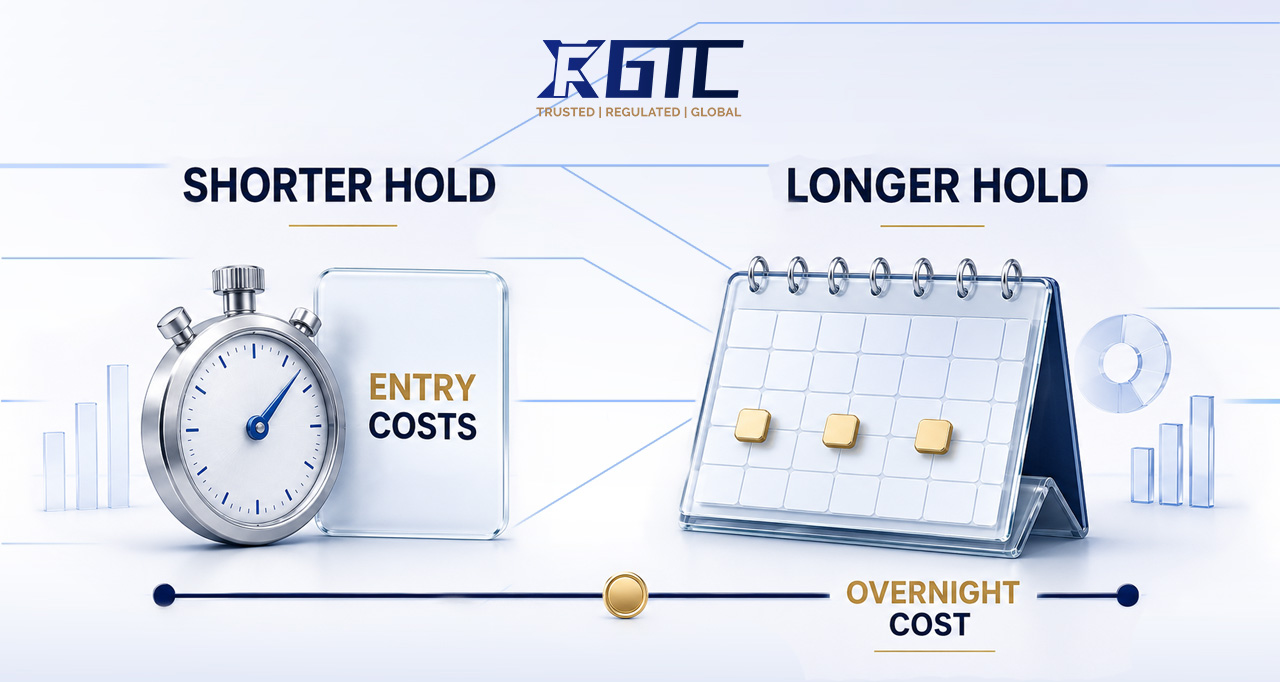
Entry costs dominate when trades are frequent and short; overnight financing becomes more important as the holding period extends.
Scalpers and day traders cross the spread many times a day and close before settlement. Spread and commission are effectively their entire cost base, and a fraction of a pip compounds into a large annual figure. Swap is irrelevant.
Swing and position traders cross the spread rarely and hold through many settlement points. A wider entry spread is often an acceptable trade for lower financing, and the swap rate on the instruments they hold deserves more attention than the headline spread.
Auditing your own costs. Take one month of closed positions from your account statement and separate the columns: gross profit and loss, commission, and swap. Divide total costs by number of trades to get your real average cost per trade, then compare that to your average winning trade. If costs consume a large share of your gross edge, the fix may be a different account structure — or fewer, larger trades rather than more, smaller ones. If the gap between expected and executed prices is material, use our guide on how to avoid slippage in trading to audit execution separately from explicit charges.
Frequently Asked Questions
What is a good spread in forex? Under 1 pip on majors for a raw-spread account before commission, or roughly 1 to 1.5 pips all-in. Always compare like with like by adding round-turn commission back into any raw-spread figure.
Is commission-free trading actually free? No. The cost sits in the spread instead. Whether that works out cheaper depends on your trade size and frequency.
How do I calculate the spread on a trade before I open it? Take the spread in pips, multiply by the pip value for your position size, and add round-turn commission if your account charges it. Do this for the instrument you are actually trading rather than assuming a EUR/USD figure carries over.
Why does my spread widen at rollover? Liquidity thins during the daily settlement changeover and around scheduled news. Both are predictable from a calendar, and both are avoidable.
Checking Your Costs at GTCFX
Different account types carry different cost structures, and the right one depends on how you trade rather than on which advertised figure looks smallest. Before opening an account, do three things.
Look at the live and average spread information for the specific instruments you intend to trade, at the hours you intend to trade them. Check the swap rates for those same instruments if you hold overnight, and confirm which day carries the multi-day charge. Then run the break-even arithmetic from the section above at your own typical position size, comparing account structures on total round-turn cost rather than on spread alone.
GTCFX publishes contract specifications, live spread information and daily swap rates for each instrument, and a demo account lets you observe how spreads behave at your own trading hours before you commit capital.
References
GTCFX, Swap Update — Live Spreads, Commissions and Daily Overnight Swap Rates, accessed August 2026. https://www.gtcfx.com/trading/swap-update
GTCFX, Forex Trading Account Types, accessed August 2026. https://www.gtcfx.com/trading/account-types
Risk Warning
Risk warning: Trading CFDs involves significant risk of loss and is not suitable for all investors. Spread and cost figures used in worked examples are illustrative; check current published rates before trading.

![Long vs Short Position in Trading Which to Choose [2026]](/_next/image?url=https%3A%2F%2Fapi.gtcfx.com%2Fuploads%2F11_85c833a930.jpg&w=1920&q=75)