CFDها ابزارهایی اهرمی و بسیار سفته‌بازانه هستند. معامله CFD ریسک بالایی برای سرمایه شما دارد. سرمایه‌گذاران باید پیش از انجام معاملات از دانش کافی بازار برخوردار باشند یا مشاوره مالی مستقل دریافت کنند.

When Does Forex Market Open? 2026 Update

Learn when the forex market opens and closes, how Sydney, Tokyo, London and New York sessions work, and how overlaps, DST and holidays affect trading activity.

  • 7 min read
  • For traders
  • Market Hours
When Does Forex Market Open? (2026 Update)

Key Takeaways

  • The forex market operates 24 hours a day, five days a week, from Sunday evening to Friday afternoon because trading activity moves across global financial centers.
  • The four major forex trading sessions are Sydney, Tokyo, London, and New York, each representing a key financial hub with different market characteristics.
  • Forex liquidity often increases when major trading sessions overlap, especially during the London-New York overlap.
  • Daylight Saving Time changes can shift displayed market hours depending on a trader's location and selected time zone.
  • Regional holidays may reduce liquidity and affect spreads because fewer institutional participants are active in the market.
01SECTION 01

What Are the Major Forex Trading Sessions?

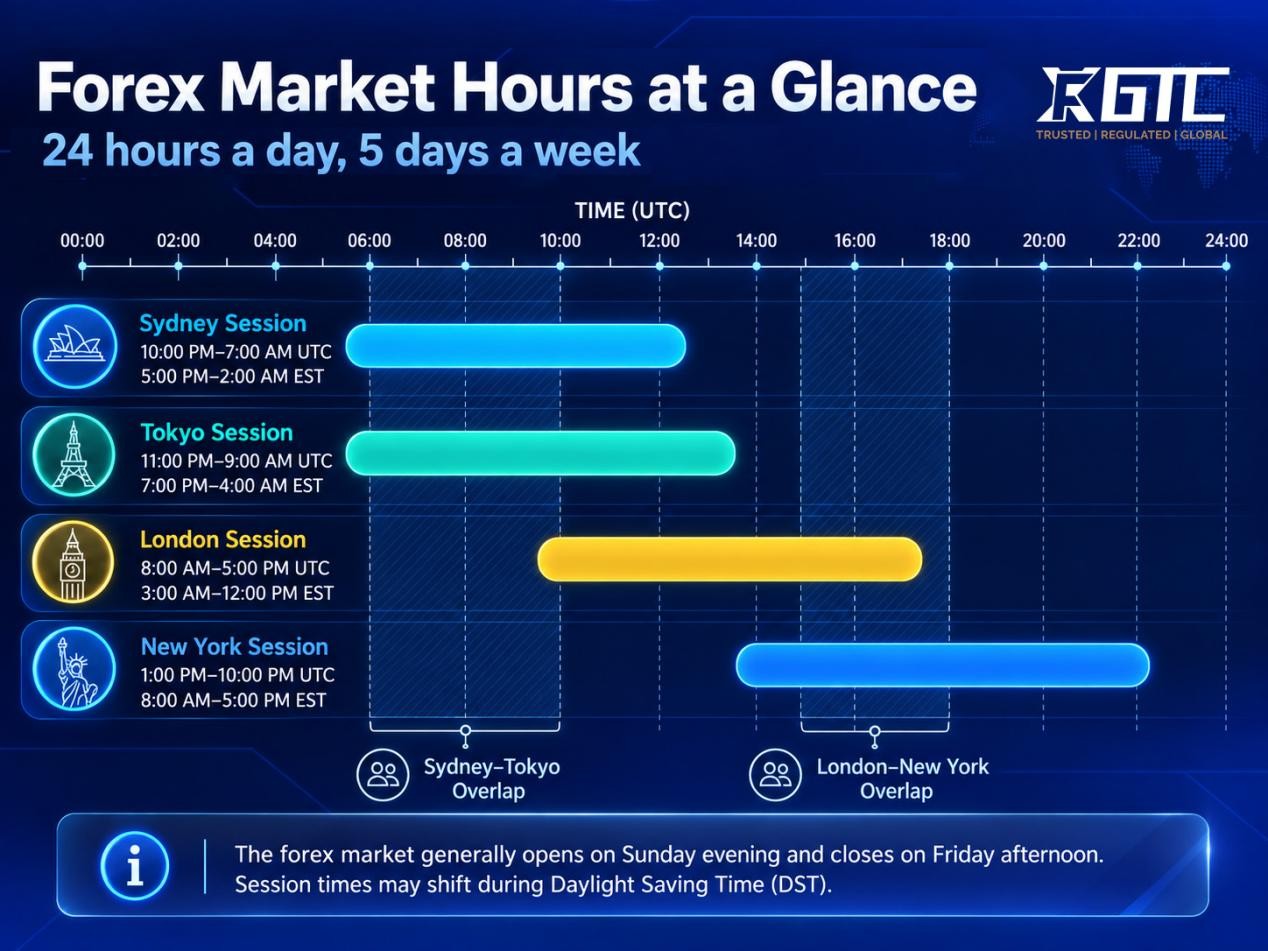
Unlike traditional stock exchanges that operate during fixed local hours, the foreign exchange market follows a global network of financial centers that keeps trading active throughout the week. The forex market generally opens on Sunday evening and closes on Friday afternoon, providing nearly continuous access across different time zones.

However, 24-hour availability does not mean market conditions remain the same throughout the day. Liquidity, volatility, and trading activity change as Sydney, Tokyo, London, and New York sessions open and close. So what to consider in forex trading? Keep scrolling.

The forex market is divided into four major trading sessions based on the world's leading financial centers: Sydney, Tokyo, London, and New York. Each session reflects regional market participation and may have different levels of liquidity, volatility, and currency focus.

Forex is a decentralized market, there is no single exchange that controls global opening and closing times. Instead, trading activity moves from one financial hub to another as the global trading day progresses.

🕑

Sydney Session

UTC 10:00 PM–7:00 AM · EST 5:00 PM–2:00 AM · Hub: Australia / New Zealand · Watched: AUD, NZD

🕑

Tokyo Session (Asian Session)

UTC 11:00 PM–9:00 AM · EST 7:00 PM–4:00 AM · Hub: Japan / Asia · Watched: JPY, AUD, NZD

🕑

London Session (European Session)

UTC 8:00 AM–5:00 PM · EST 3:00 AM–12:00 PM · Hub: United Kingdom / Europe · Watched: EUR, GBP, CHF

🕑

New York Session (North American Session)

UTC 1:00 PM–10:00 PM · EST 8:00 AM–5:00 PM · Hub: United States / North America · Watched: USD, CAD

Note: Forex session times may shift depending on Daylight Saving Time (DST) changes and the trader's selected time zone.

01

The London-New York Overlap (13:00–17:00 GMT)

The London-New York overlap is widely monitored because two of the largest forex markets operate simultaneously.

This period typically occurs around:

  • 8:00 AM – 12:00 PM EST
  • 1:00 PM – 5:00 PM GMT

During this overlap, liquidity often increases because European and North American participants are active at the same time. Major currency pairs, including EUR/USD and GBP/USD, may experience higher trading volume and more noticeable price movements.

Traders researching trading session times EST often pay attention to this period since it aligns with major US economic announcements and active European market hours.

However, increased activity does not automatically indicate favorable conditions for every strategy. Some traders prefer higher volatility, while others may focus on calmer market environments.

02

The Sydney-Tokyo Overlap (00:00–07:00 GMT)

The Sydney-Tokyo overlap represents the transition between Australian and Asian market activity.

During this period:

  • AUD and NZD pairs may receive increased attention
  • regional economic data can influence price movements
  • liquidity may improve compared with the earlier Sydney session

Although this overlap generally has lower activity than the London-New York period, it can still be relevant for traders focusing on Asia-Pacific currencies.

03

Lower-Liquidity Periods

Some periods of the trading day experience lower participation because major financial centers are between sessions. Lower liquidity may affect:

  • bid/ask spreads
  • price movement patterns
  • order execution conditions

For example, the period after New York closes and before Asian markets become fully active often sees reduced market participation.

Therefore, you should monitor these periods carefully, especially when trading strategies depend on short-term price movements.

02SECTION 02

How Do Daylight Saving Time and Holidays Affect Forex Trading Hours?

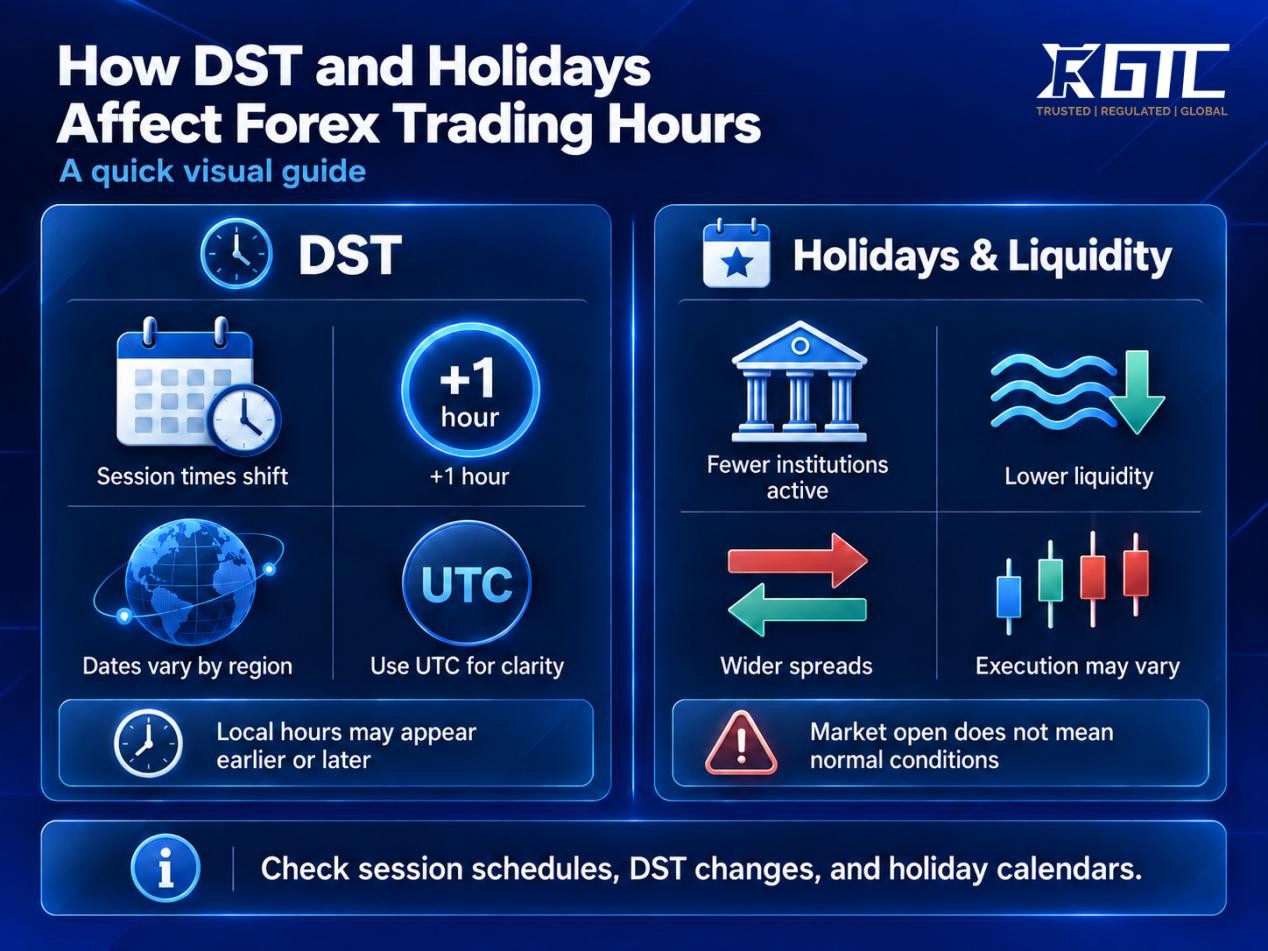
Forex trading hours are global, but displayed session times can change because, you know, countries follow different time zone rules. Holidays can also affect liquidity because fewer institutional participants may be active in the market.

04

The Global Impact of Daylight Saving Time (DST)

Daylight Saving Time creates seasonal changes in how trading hours appear across regions. While financial markets usually maintain their local operating schedules, the conversion between time zones can shift during DST transitions. For example:

  • The United States and Europe do not switch to DST on the same date.
  • Some countries, including Japan, China, Hong Kong, Singapore, and India, do not observe DST.
  • The same forex session may appear one hour earlier or later depending on the trader's location.

These differences can affect traders who follow specific session schedules, economic releases, or automated trading systems. Professional trading systems often use Coordinated Universal Time (UTC) internally to reduce confusion caused by seasonal time changes.

05

Holiday Trading Liquidity and Spread Risks

Although the forex market does not completely close because of most regional holidays, liquidity can change when major financial institutions are unavailable. During holidays such as US or UK bank holidays:

  • fewer institutional participants may be active
  • trading volume can decrease
  • spreads may become wider
  • price movements may behave differently

For example, when US equity markets close during major federal holidays, broader market participation may also decline.

Traders should consider holiday schedules when evaluating market conditions, especially if their approach relies on short-term execution or high liquidity environments.

Conclusion

GTCFX provides access to global CFD markets, including forex, metals, indices, shares, and other instruments through platforms such as MT4, MT5, and GTC Go. You can explore available tools and market access options based on their own trading preferences and requirements.

03SECTION 03

Frequently Asked Questions

The major forex market generally closes after Friday afternoon and reopens on Sunday evening when trading activity begins in Asia-Pacific markets.

During weekends, traditional forex liquidity is limited because major financial centers and institutional participants are not operating normally. Some other markets, such as cryptocurrencies, may follow different trading schedules.

Risk Warning

This content is for educational purposes only and does not constitute financial advice. Trading involves significant risk, and you may lose your capital.

GTCFX operates as a multi-regulated group of companies. Clients are kindly advised to confirm the specific legal entity, regulation and jurisdiction under which they are being onboarded.

اشتراک‌گذاری این مقاله

مطالب بیشتر از Blogs

How to Choose a Forex Broker in Dubai Regulation, Costs and Platforms

Blogs

How to Choose a Forex Broker in Dubai Regulation, Costs and Platforms

Low spreads, high leverage and local support can make forex trading brokers in Dubai look similar at first glance. Yet account terms can differ in ways that affect trading costs, deposits and withdrawals, and client protection. Those differences become especially important when positions remain open overnight or funds need to be withdrawn.

Why Are My FOREX Trading Costs So High?

Blogs

Why Are My FOREX Trading Costs So High?

Learn what drives forex trading costs and how to calculate the full cost of a trade. Compare spreads, commissions and financing, and explore GTCFX Standard and ECN account pricing.

How to Avoid Requotes in FOREX Trading?

Blogs

How to Avoid Requotes in FOREX Trading?

Understand why forex requotes happen and how to reduce them. Learn about execution models, maximum deviation, market conditions, limit orders and GTCFX trading options.

How to Make a Forex Withdrawal on GTC Go (GTCFX Guide)?

Blogs

How to Make a Forex Withdrawal on GTC Go (GTCFX Guide)?

GTC Go is GTCFX's mobile trading app, giving traders quick access to accounts, markets, and fund management. As a regulated forex broker, GTCFX aims to make every forex withdrawal on GTC Go simple and secure.

How to Deposit Money into GTCFX-A Step-by-Step Guide?

Blogs

How to Deposit Money into GTCFX-A Step-by-Step Guide?

Depositing funds into your trading account is an essential step before you start trading with GTCFX. This guide explains how to deposit money into GTCFX, including available payment methods, processing times, fees, and key considerations to help you complete your deposit smoothly.

10 Best Forex Trading Indicators and How to Use Them

Blogs

10 Best Forex Trading Indicators and How to Use Them

In forex trading, timing can make the difference between a smart entry and a costly mistake. But with prices moving constantly, how can traders spot meaningful opportunities without relying on guesswork? That’s where forex trading indicators come in. From identifying trends and momentum to measuring volatility and potential reversals, the right indicators can help you make more informed decisions.

What Is the Strongest Currency in the World?

Blogs

What Is the Strongest Currency in the World?

Explore the strongest currencies in 2026 by nominal value, including the Kuwaiti dinar, Bahraini dinar, Omani rial, Jordanian dinar and British pound, plus the factors that influence currency strength and forex trading.

نحوه فعال‌سازی بدون سواپ؛ سریع و شفاف

فعال‌سازی ساده استتماس بگیرید تا تیم اختصاصی ما باقی مراحل را انجام دهد. بدون کاغذبازی یا مراحل پنهان؛ فقط یک درخواست ساده.
چگونه حالت بدون سواپ را فعال کنم؟از طریق گفت‌وگوی زنده یا ایمیل با پشتیبانی تماس بگیرید. صلاحیت شما را بررسی و پس از تأیید، حالت بدون سواپ را برای حسابتان فعال می‌کنیم.
گفت‌وگوی زندهپشتیبانی فوری 24/7ایمیلsupport@gtcfx.com